

The good life is a process, not a state of being. It is a direction not a destination.
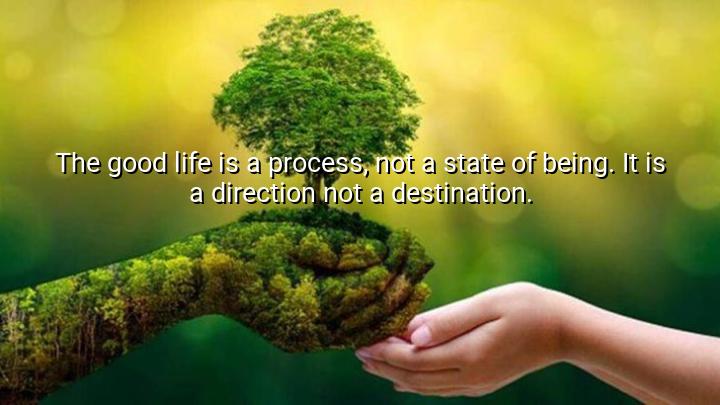




Carl Rogers’s quote challenges the traditional view of happiness or the good life as a fixed, achievable goal. By saying, "The good life is a process, not a state of being," Rogers emphasizes that personal growth and fulfillment are ongoing journeys rather than static achievements. The quote suggests that life itself, in all its complexity, is a continual process of development, self-discovery, and change, rather than a point that can be reached and then enjoyed permanently.
The second part of the quote, "It is a direction not a destination," reinforces the idea that well-being is about the path we take and the choices we make rather than a final end point. This means that success, peace, and happiness are not defined by external markers, but by the direction we move in—toward self-actualization, purpose, and meaning. Rogers encourages individuals to focus on their personal journey and the small steps they take to align with their core values and goals, rather than seeking a final state that may be elusive.
Rogers, a prominent psychologist and one of the founders of humanistic psychology, believed that people have an inherent desire for growth and self-improvement. His quote reflects the central tenet of his work: that individuals are capable of realizing their full potential through a process of continuous personal development. This process is not about achieving perfection but about living authentically and embracing change.
The origin of the quote lies in Rogers's emphasis on experiential living and self-actualization. His work, which focused on the importance of human experience and the ability to grow within a supportive environment, is reflected in this quote. He saw the good life as a journey of ongoing experiences and learning, rather than an elusive end state, encouraging people to embrace their path and trust in the process of becoming their best selves.

AAdministratorAdministrator
Welcome, honored guests. Please leave a comment, we will respond soon