

The god of love lives in a state of need. It is a need. It is an urge. It is a homeostatic imbalance. Like hunger and thirst, it's almost impossible to stamp out.
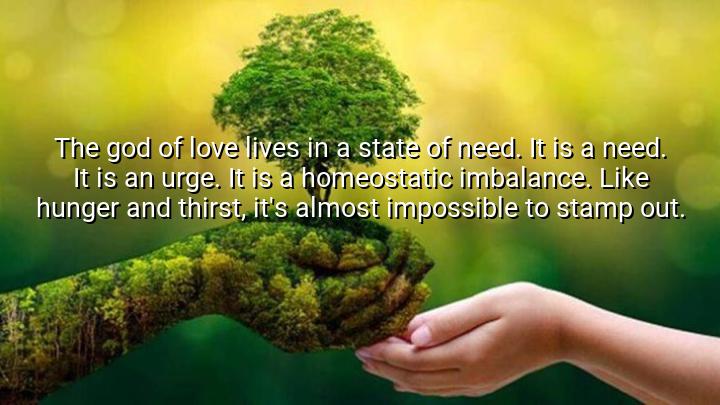




The quote “The god of love lives in a state of need. It is a need. It is an urge. It is a homeostatic imbalance. Like hunger and thirst, it's almost impossible to stamp out” by Plato explores the innate and persistent nature of love. Plato portrays love not as a fleeting emotion but as a fundamental human drive that arises from a deep sense of lack or desire. Just as hunger and thirst compel humans to seek sustenance, love motivates individuals to seek connection, intimacy, and fulfillment.
The origin of this idea comes from Plato, the ancient Greek philosopher, particularly through his dialogues on Eros, the god of love, in works like the Symposium. In these texts, Plato examines love as a motivating force that arises from incompleteness or need, suggesting that humans pursue love to achieve a sense of wholeness or balance. By describing love as a homeostatic imbalance, he likens it to a natural and unavoidable drive in the human psyche.
This quote emphasizes that love is not merely a choice but a profound and enduring urge that shapes human behavior. It is both powerful and necessary, compelling individuals to seek emotional, intellectual, and sometimes spiritual connection. Plato’s perspective highlights that the pursuit of love is deeply ingrained, almost impossible to eliminate, and essential to the human experience.
Ultimately, Plato’s insight encourages an understanding of love as a fundamental force of nature rather than a simple preference or feeling. Recognizing it as a persistent need helps explain its intensity, its ability to inspire creativity, and its central role in human life and fulfillment. It shows that love is a driving energy that shapes both our desires and our actions in profound ways.
I can also create a condensed version suitable for a quick reflection or discussion.

AAdministratorAdministrator
Welcome, honored guests. Please leave a comment, we will respond soon