

The future of food security will depend on a combination of the ecological prudence of the past and the technological advances of today.
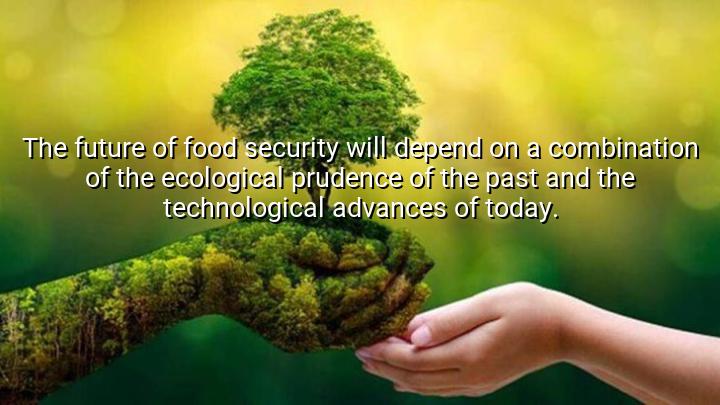




This quote by M. S. Swaminathan, "The future of food security will depend on a combination of the ecological prudence of the past and the technological advances of today," highlights the need for a balanced approach to addressing global food security challenges. Swaminathan emphasizes that securing a reliable and sufficient food supply for future generations cannot rely solely on modern technology or past traditional practices—instead, it requires integrating the sustainable wisdom of the past with the scientific innovations of the present.
The phrase "ecological prudence of the past" refers to time-tested agricultural methods that respected natural cycles, maintained soil fertility, and preserved biodiversity. These methods were often rooted in community knowledge and demonstrated a strong connection to the environment. In contrast, "technological advances of today" represents modern tools like genetic engineering, climate-smart agriculture, and digital farming, which can significantly improve yields and resource efficiency, especially in the face of climate change and population growth.
M. S. Swaminathan, known as the father of the Green Revolution in India, played a pivotal role in transforming Indian agriculture through the adoption of high-yielding crop varieties and improved farming techniques. His work helped lift millions out of famine and poverty, but he also recognized the environmental costs of unchecked industrial agriculture. This quote reflects his deep belief in the necessity of sustainable development, where agricultural productivity is enhanced without degrading the natural resource base.
Ultimately, Swaminathan’s quote serves as a visionary reminder that the path to global food security lies in combining respect for nature with cutting-edge innovation. It is a call to action for policymakers, scientists, and farmers alike to forge a future where agriculture is not only productive but also resilient, inclusive, and environmentally responsible.

AAdministratorAdministrator
Welcome, honored guests. Please leave a comment, we will respond soon