

The fundamental dogma of Modernism - that, if the past is irrelevant to the future, then today is irrelevant to tomorrow - has created a throwaway society of disposable objects. That is sick.
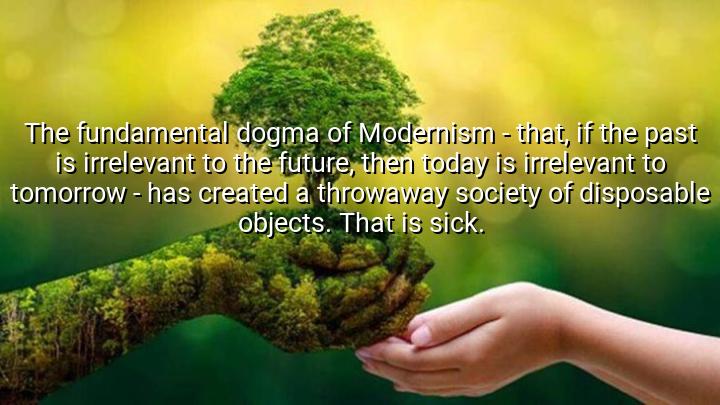




In this quote, Marcel Wanders critiques the core belief of Modernism, which he describes as the idea that if the past no longer matters to the future, then the present (or today) is also irrelevant to what comes next. Wanders connects this philosophy to the creation of a throwaway society, where items and values are discarded without consideration for their long-term impact. He argues that the mentality of disposability in modern culture—whether in terms of objects or ideas—has led to a shallow approach to life and consumption, where things are used only briefly before being thrown away.
Wanders’ criticism highlights the consequences of short-term thinking and the lack of respect for the continuity between past, present, and future. He suggests that by disregarding the value of history and the future, society has adopted a mindset that prioritizes immediate satisfaction and convenience over sustainability and longevity. The result is a culture that treats both material goods and values as temporary, easily replaced, and ultimately less meaningful.
The origin of this quote can be traced to Marcel Wanders' work as a designer, known for his innovative and thought-provoking approach to design. Wanders often incorporates elements that challenge modern trends and explore the deeper implications of consumerism and the design industry. His critique of Modernism and its impact on society reflects his broader interest in sustainability, the preservation of cultural values, and the meaningfulness of design in everyday life.
Ultimately, Wanders’ words serve as a call to reconsider the consequences of a throwaway culture that prioritizes convenience over sustainability and values the present without considering its connection to the past or the future. His critique encourages a more thoughtful, long-term approach to both design and consumption, promoting the idea that everything—whether objects or ideas—should be valued and preserved for its lasting impact.

AAdministratorAdministrator
Welcome, honored guests. Please leave a comment, we will respond soon