

The first requisite for the happiness of the people is the abolition of religion.
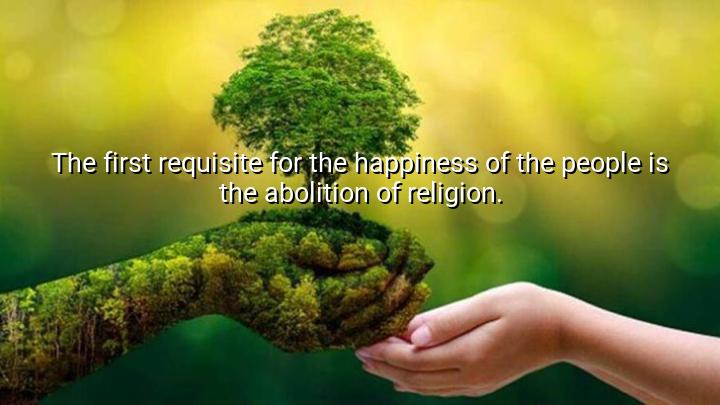




Karl Marx’s quote suggests that the abolition of religion is a necessary step for the happiness of people. Marx believed that religion, particularly in its institutionalized form, served as a tool of oppression, distracting individuals from addressing the real issues of inequality and social injustice. He famously referred to religion as the "opiate of the masses," meaning it numbs people to the harsh realities of their lives, preventing them from seeking true freedom and fulfillment.
Marx's view reflects his belief in materialism and economic theory, where he argued that the structures of society, including religion, are shaped by material conditions rather than spiritual or ideological beliefs. For Marx, true happiness and liberation could only be achieved through radical social and economic change — namely the abolition of class structures and the establishment of a classless society. Religion, in his view, acted as an obstacle to this process by promoting submission to authority and acceptance of the status quo.
The origin of this quote stems from Marx's broader critique of capitalism and social structures. In works like The Communist Manifesto and Critique of Hegel’s Philosophy of Right, Marx argued that societal systems, including religion, were designed to maintain the dominance of the ruling class. He believed that once people realized their true material conditions and the need for revolution, they would no longer require religion to offer comfort or justification for their suffering.
Marx's statement is part of his larger philosophical framework that views religion as a form of ideological control. His call for its abolition reflects his commitment to building a society where human happiness is not dependent on supernatural beliefs but on real, tangible changes in social and economic structures. This view places human agency and empowerment at the center of Marxist thought, rejecting religion as an external force that keeps people from achieving true freedom and happiness.

AAdministratorAdministrator
Welcome, honored guests. Please leave a comment, we will respond soon