

The exercise of power is determined by thousands of interactions between the world of the powerful and that of the powerless, all the more so because these worlds are never divided by a sharp line: everyone has a small part of himself in both.
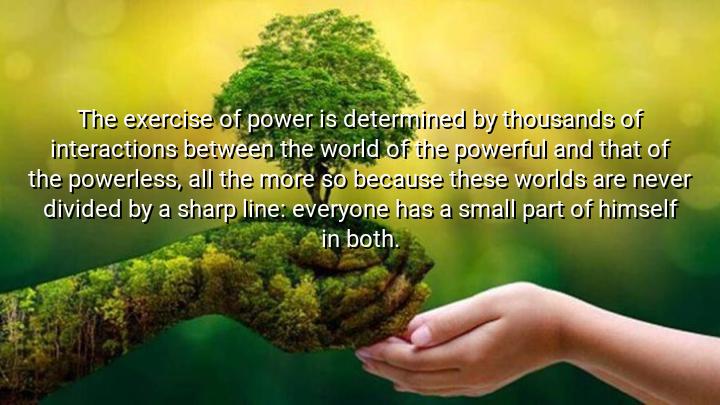




In this quote, Vaclav Havel reflects on the complex and interconnected nature of power and powerlessness. He suggests that the exercise of power is not a simple one-way relationship, but rather the result of countless interactions between the powerful and the powerless. These interactions are shaped by the fact that the worlds of the powerful and powerless are not entirely distinct from one another; instead, they overlap, and every person holds a small part of both within themselves.
Havel’s insight underscores the idea that power is not fixed or absolute, but fluid and dependent on the dynamics between individuals and groups. Even those who seem powerless may have influence or agency in certain contexts, while those with power may also be vulnerable in different aspects of life. This complexity challenges the notion that power is strictly binary, highlighting the shared humanity and interdependence between all people, regardless of their social or political status.
The origin of this quote lies in Havel's own experiences as a dissident in Czechoslovakia under communist rule. As an advocate for human rights and freedom, Havel often emphasized the moral responsibility of both the powerful and the powerless. He believed that true change could only come when individuals in positions of power recognized their own vulnerability and when those who were oppressed understood their potential to influence change.
Ultimately, Havel’s quote calls for a more nuanced understanding of power and social dynamics. It suggests that in order to create a fairer, more just society, we must recognize the interconnectedness of all individuals and the ways in which power operates across various levels of society. By acknowledging that everyone has a part of both worlds, Havel emphasizes the need for empathy, awareness, and shared responsibility in navigating the complexities of power.

AAdministratorAdministrator
Welcome, honored guests. Please leave a comment, we will respond soon