

The earth is my altar, the sky is my dome, mind is my garden, the heart is my home and I'm always at home - yea, I'm always at Om.
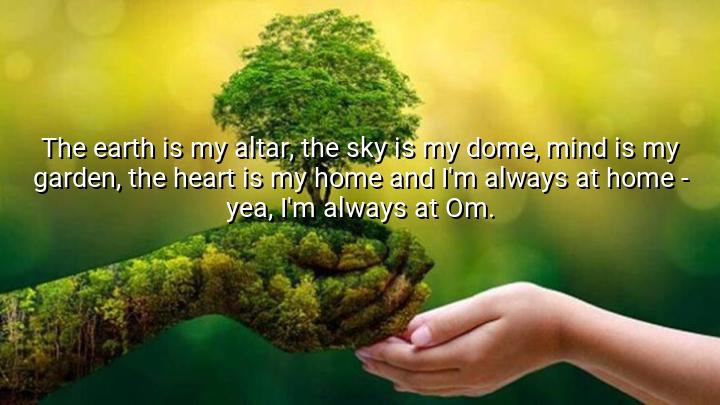




In this quote, Eden Ahbez, a notable figure in the counterculture movement of the 20th century, expresses a profound connection to the natural world and a deep sense of inner peace. By stating that "the earth is my altar," Ahbez aligns himself with the spiritual aspects of nature, seeing the earth itself as a sacred space. This reflects his belief in the power of nature as a source of spiritual renewal and connection to something greater than oneself.
The phrase "the sky is my dome" suggests a sense of freedom and expansiveness, as if the sky itself forms a protective, boundless shelter for the individual. Ahbez conveys that the universe—both the physical world and the spiritual realm—is his place of refuge, where he finds solace and harmony. The line also highlights a holistic view of existence, where everything around him is interconnected, and nature becomes a sanctuary.
The reference to the mind as a garden represents the idea that the mind is a place that must be nurtured and cultivated. Like a garden, it requires care, attention, and growth. Ahbez emphasizes that inner peace comes from tending to one's mental state and cultivating a space of clarity and serenity. The heart being his home ties into the idea of love, emotional grounding, and the importance of inner peace in shaping one’s sense of belonging and identity.
The concluding phrase, "I'm always at Om," alludes to the sacred sound of Om, often associated with meditation, spiritual awakening, and the interconnectedness of all things. Ahbez suggests that he is in a constant state of alignment and tranquility, always centered within himself and in harmony with the universe. Ultimately, the quote embodies a philosophy of being at peace with both the external world and one's own inner being, where spirituality and nature blend seamlessly into a state of ongoing serenity.

AAdministratorAdministrator
Welcome, honored guests. Please leave a comment, we will respond soon