

The day which we fear as our last is but the birthday of eternity.
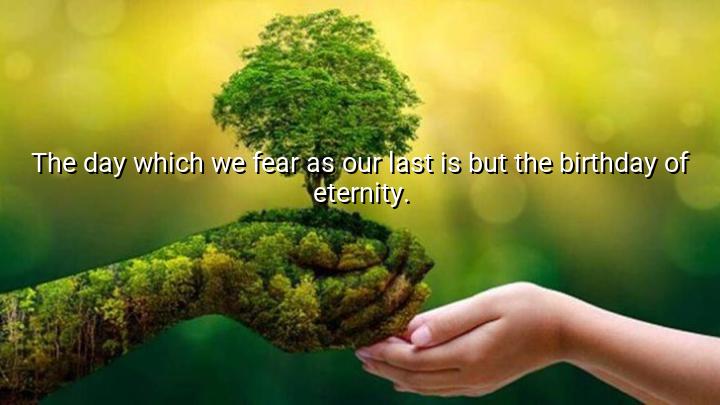




In this quote, Lucius Annaeus Seneca explores the concept of death and its relationship to eternity. He suggests that the day we fear most—the day of our death—is actually the beginning of something greater: the birthday of eternity. Seneca reimagines death not as an end, but as a transition into an eternal existence. This perspective shifts the focus from fear to a more philosophical and even spiritual view of life and death as part of an ongoing cycle.
Seneca’s words challenge the common human tendency to view death as a final, terrifying event. By referring to it as a birthday, he emphasizes that death is not something to dread but rather a natural and inevitable part of the journey that leads us into eternity. This aligns with his Stoic philosophy, which teaches acceptance of life’s natural course and the importance of embracing both life and death with equanimity.
The quote also encourages a reflection on the nature of time and how we view our own mortality. Instead of seeing death as a tragic end, Seneca invites us to see it as part of the greater continuum of existence. By doing so, we may find peace in the idea that life and death are interconnected, and that death itself is not to be feared but acknowledged as a transition into something infinite.
Ultimately, Seneca’s quote offers a profound perspective on mortality, urging us to reconsider our attitudes toward death and to view it as the beginning of a new phase, rather than the end of our existence. By redefining death in this way, he encourages us to live more fully in the present, embracing the impermanence of life as part of the larger cycle of eternity.

AAdministratorAdministrator
Welcome, honored guests. Please leave a comment, we will respond soon