

The country that is more developed industrially only shows, to the less developed, the image of its own future.
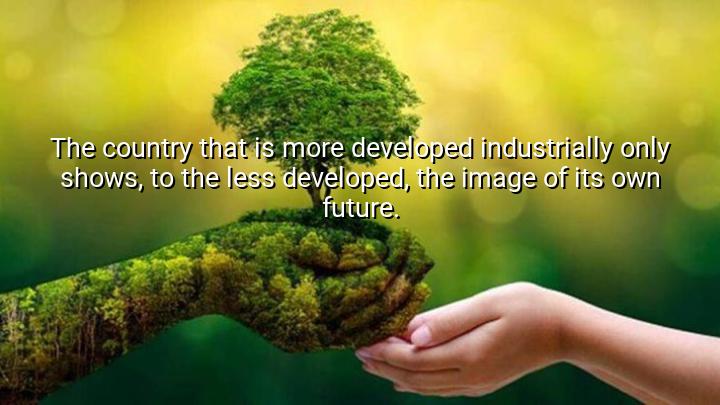




The quote by Karl Marx highlights the relationship between industrial development and the growth of nations, specifically in terms of economic disparity. Marx argues that more industrially advanced countries represent the future that less developed nations might face if they continue their current paths of economic and social development. This suggests that industrialization is inevitable, and the progress of one nation can serve as a model for another's potential future.
The origin of this idea is rooted in Marx's broader theory of historical materialism, where he asserts that the economic base of society determines its social structure and political ideology. In this context, Marx saw industrial development as the driving force behind the changes in both the economic system and the political power of nations. More developed nations, having gone through this industrial transformation, act as the "models" for the future trajectory of less developed nations.
Marx's view reflects his belief in the inevitability of capitalist expansion and the eventual transition to socialism. He saw the industrial revolution as a transformative period that would eventually spread across the globe. In this light, the quote implies that countries at different stages of development are connected through their shared economic processes, even if they are at different stages of industrialization.
The quote also underscores Marx's view of exploitation: more industrialized countries often exploit the resources and labor of less developed nations. Therefore, the "image of its own future" isn't necessarily a hopeful or prosperous future but one marked by the same capitalist systems of inequality that the advanced nations experience.

AAdministratorAdministrator
Welcome, honored guests. Please leave a comment, we will respond soon