

The countries who do the best in international comparisons, whether it's Finland or Japan, Denmark or Singapore, do well because they have professional teachers who are respected, and they also have family and community which support learning.
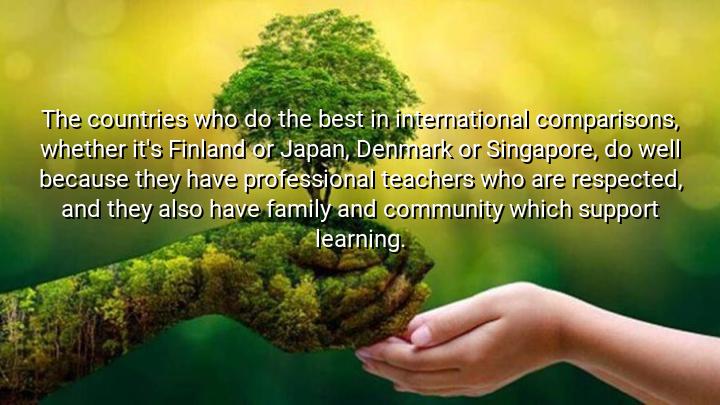




In this quote, Howard Gardner, a renowned psychologist and educator, highlights the key factors that contribute to the success of educational systems in countries like Finland, Japan, Denmark, and Singapore. Gardner argues that these nations excel in international comparisons because they prioritize two critical elements: professional teachers who are highly respected in society, and a strong sense of family and community support for learning. These elements work together to create an environment where education thrives, benefiting both students and teachers.
Gardner emphasizes that in successful educational systems, teachers are not only well-trained but also held in high esteem by the public. This respect allows teachers to focus on teaching and continuously improve their craft without the distractions of low status or lack of support. Additionally, he underscores the importance of family and community involvement in the educational process, suggesting that when the broader society values education, children are more likely to succeed academically.
The origin of this quote comes from Gardner’s long-standing work on multiple intelligences and his interest in the factors that contribute to effective education. As a professor at Harvard University, Gardner has spent decades researching how different societies approach education and what makes some systems more effective than others. This quote reflects his belief that a combination of teacher professionalism, community engagement, and cultural respect for learning leads to better educational outcomes.
Ultimately, Gardner’s quote serves as a reminder that successful education systems require more than just policies or resources—they also depend on societal values that elevate teaching and promote a culture of learning. By fostering environments where teachers are respected and families and communities support education, countries can build systems that promote long-term academic success.

AAdministratorAdministrator
Welcome, honored guests. Please leave a comment, we will respond soon