

The conscious mind may be compared to a fountain playing in the sun and falling back into the great subterranean pool of subconscious from which it rises.
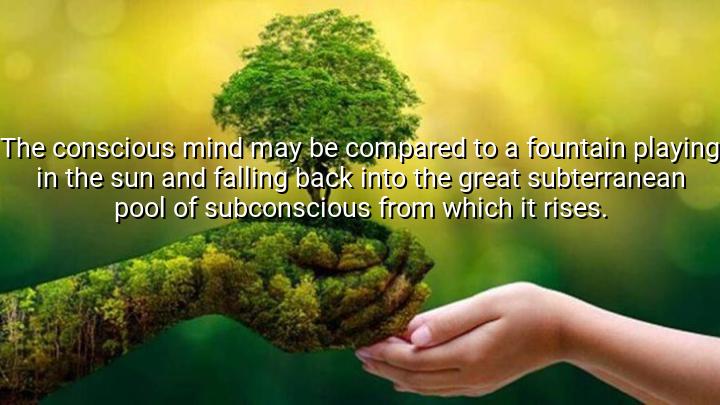




The quote "The conscious mind may be compared to a fountain playing in the sun and falling back into the great subterranean pool of subconscious from which it rises" by Sigmund Freud uses a metaphor to describe the relationship between the conscious and subconscious mind. Freud suggests that the conscious mind, like a fountain, is in the open and easily observable, constantly influenced by the sun (representing external stimuli or awareness). However, it falls back into the subconscious, which is deeper, hidden, and represents the part of the mind that influences behavior without conscious awareness.
In this analogy, the conscious mind is what we are actively aware of—our thoughts, decisions, and feelings in the present moment—while the subconscious represents the underlying, often hidden layers of thought that shape our behaviors and desires, influenced by past experiences, memories, and instincts. Freud’s comparison implies that our conscious thoughts are temporary, only briefly above the surface of the mind before they return to the subconscious, where they are stored and occasionally rise again.
The origin of this quote comes from Freud’s exploration of the psyche and his theories on how the conscious and unconscious parts of the mind work together to influence human behavior. Freud, the father of psychoanalysis, focused much of his research on the subconscious mind and how it shapes our actions and perceptions without us being fully aware of it. This quote captures his belief that the subconscious plays a crucial, often unseen role in shaping our lives.
Ultimately, the quote underscores Freud's view that the subconscious mind is a powerful force in shaping who we are, with the conscious mind being only a fleeting reflection of the much deeper, more complex mental processes at play. The metaphor of a fountain falling back into a subterranean pool illustrates the continual ebb and flow between awareness and hidden mental forces, a central theme in Freud’s psychoanalytic theory.

AAdministratorAdministrator
Welcome, honored guests. Please leave a comment, we will respond soon