

The business of the poet is not to find new emotions, but to use the ordinary ones and, in working them up into poetry, to express feelings which are not in actual emotions at all.
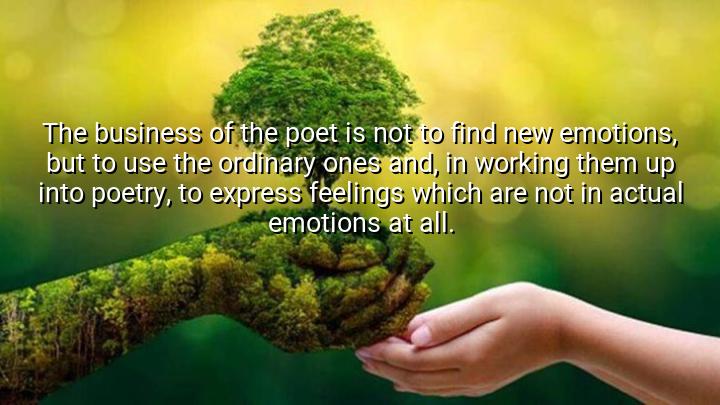




The quote by T. S. Eliot, "The business of the poet is not to find new emotions, but to use the ordinary ones and, in working them up into poetry, to express feelings which are not in actual emotions at all," reflects Eliot’s view on the true purpose of poetry. He argues that the poet does not need to seek out extraordinary or novel emotions but should instead transform common, everyday feelings into something deeper and more universal. By doing so, poetry can capture feelings that transcend immediate emotional experiences, reaching a more profound level of human understanding.
The origin of this quote lies in Eliot’s essays on literary criticism, particularly his belief that art should channel and refine emotion rather than simply reproduce it. He distinguished between personal emotion and the more abstract feelings conveyed through carefully crafted poetry. For Eliot, a poet’s "business" was the skillful manipulation of language and imagery to evoke sensations and ideas that resonate beyond their original context.
On a deeper level, the quote suggests that great poetry does not rely on the novelty of its subject matter but on the poet’s ability to transform the ordinary into the extraordinary. Eliot believed that poetry could take familiar experiences and elevate them, allowing readers to perceive dimensions of life that might otherwise go unnoticed. This process involves technique, imagination, and a mastery of poetic craft rather than raw, spontaneous emotion.
Ultimately, Eliot’s statement redefines the role of the poet. Rather than chasing unique emotional experiences, the poet’s task is to work with the emotions already present in life and shape them into something enduring. In doing so, poetry becomes a bridge between the everyday and the eternal, capturing truths that cannot be fully expressed through ordinary emotional expression alone.

AAdministratorAdministrator
Welcome, honored guests. Please leave a comment, we will respond soon