

The best part of beauty is that which no picture can express.
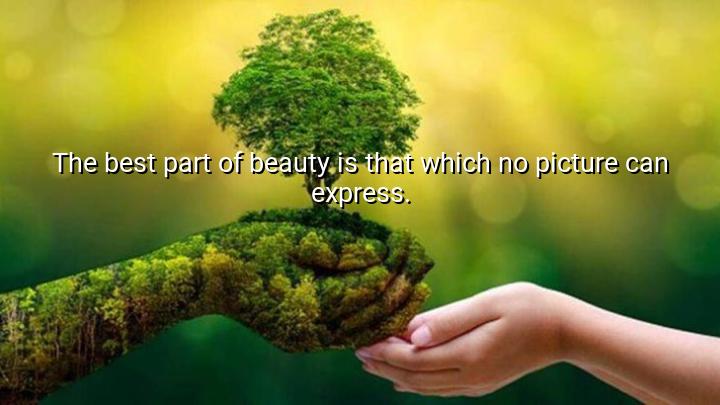




The quote by Francis Bacon, “The best part of beauty is that which no picture can express,” emphasizes the intangible and ineffable qualities of beauty that go beyond what can be captured visually. Bacon suggests that while art and images can depict external appearances, the deepest essence of beauty lies in something more profound—perhaps an inner spirit, emotion, or energy that cannot be fully represented through a mere picture. This highlights the limitations of physical representation when it comes to capturing the true nature of beauty.
Francis Bacon, an English philosopher, statesman, and essayist of the late 16th and early 17th centuries, is often considered the father of the scientific method, but he also wrote extensively on aesthetics and human perception. His philosophical approach balanced empirical observation with a recognition of the mysteries of human experience. This quote reflects his understanding that some aspects of beauty transcend objective description and require a more subjective, experiential appreciation.
The phrase “no picture can express” implies that beauty involves qualities that evoke feeling and intuition, which are beyond the grasp of visual art alone. It may refer to the emotional impact, the radiance of personality, or the presence someone or something holds, which can touch us deeply without being visible. This idea invites us to look beyond appearances and seek beauty in the essence and experience.
Ultimately, Bacon’s quote invites us to recognize the depth and complexity of beauty. It challenges the assumption that beauty is solely about what is seen and reminds us that the most meaningful and moving aspects of beauty often reside in the unseen—in the feelings and connections that art can inspire but never fully capture.

AAdministratorAdministrator
Welcome, honored guests. Please leave a comment, we will respond soon