

The best lack all conviction, while the worst are full of passionate intensity.
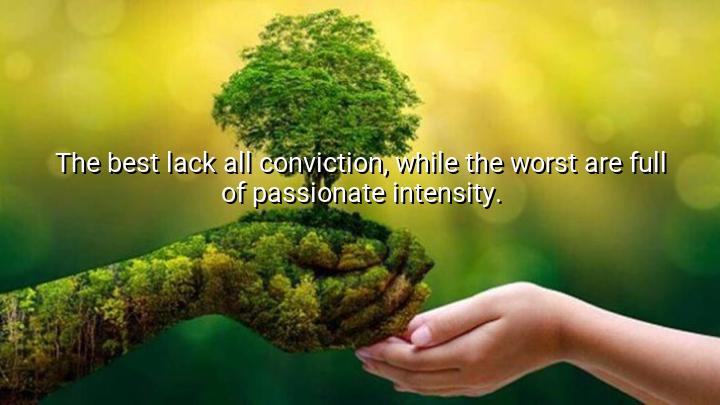




The quote by William Butler Yeats, "The best lack all conviction, while the worst are full of passionate intensity," speaks to the troubling dynamics of moral and social upheaval. Yeats suggests that those who are the best—the wise, the just, and the morally grounded—often hesitate or remain silent, lacking the firm conviction needed to act decisively. Meanwhile, the worst—those with destructive or harmful intentions—are often the most vocal and driven, their intensity allowing them to dominate. This imbalance can lead to chaos and the triumph of harmful ideologies.
The words conviction and intensity highlight the contrast between thoughtful restraint and unbridled zeal. Yeats is lamenting that in times of crisis, the very people who could guide society toward justice may falter in action, leaving a vacuum that is filled by the loudest and often most dangerous voices. This observation is not only a commentary on individual behavior but also on the broader patterns of political and social movements.
The origin of this quote comes from Yeats’ 1919 poem "The Second Coming", written in the aftermath of World War I. The poem reflects Yeats’ despair at the state of the world, as he witnessed the collapse of old orders and the rise of violent and extreme forces. This line captures the sense of disillusionment and fear that the people with the most wisdom may be too hesitant to stop the spread of chaos.
Ultimately, Yeats’ words serve as a warning about the consequences of passivity. When the best remain quiet or indecisive, it allows the worst to take control with their passionate intensity. This quote continues to resonate today as a reminder that good intentions must be matched with action if society is to avoid being overwhelmed by destructive forces.

AAdministratorAdministrator
Welcome, honored guests. Please leave a comment, we will respond soon