

The agony of my feelings allowed me no respite; no incident occurred from which my rage and misery could not extract its food.
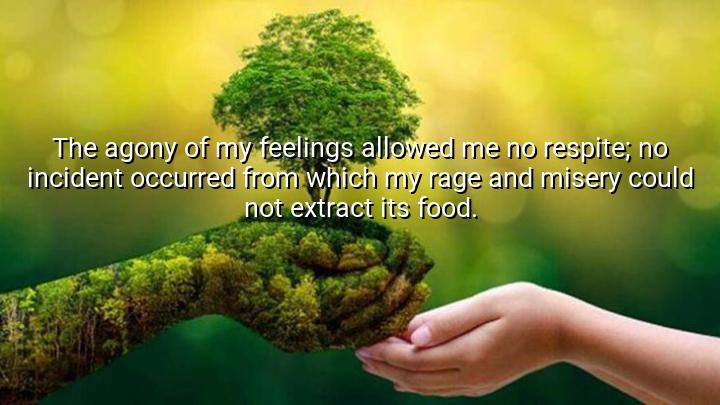




The quote "The agony of my feelings allowed me no respite; no incident occurred from which my rage and misery could not extract its food." by Mary Shelley appears in her groundbreaking novel Frankenstein (1818), a cornerstone of Gothic literature and early science fiction. Spoken by Frankenstein’s creature, this line expresses the intense emotional torment and isolation he experiences after being rejected by society and even his creator. Shelley uses this moment to explore the destructive power of unchecked emotion and unresolved pain.
The phrase "no respite" emphasizes the relentless suffering the creature endures. His emotions are so overwhelming that he finds no relief, no moment of peace. Furthermore, the idea that "rage and misery could not extract its food" from even the most mundane events paints a vivid picture of how grief and anger can consume a person completely. Here, Shelley shows that these negative emotions feed on life itself, intensifying through every interaction and observation.
This quote also highlights Shelley’s deeper themes of alienation, revenge, and the consequences of emotional neglect. The creature’s torment reflects a longing for acceptance, but having been denied compassion and connection, his pain transforms into destructive energy. Shelley presents a psychological portrait of someone whose humanity is twisted by constant rejection, and whose suffering becomes self-sustaining.
Ultimately, Mary Shelley’s words remind us of the profound need for empathy and belonging. When individuals are deprived of love and understanding, their emotions can spiral into bitterness and despair. This quote is a haunting testament to how unresolved trauma can dominate one's inner world, making even neutral events sources of pain and fuel for further anguish.

AAdministratorAdministrator
Welcome, honored guests. Please leave a comment, we will respond soon