

Shall I not have intelligence with the earth? Am I not partly leaves and vegetable mould myself.
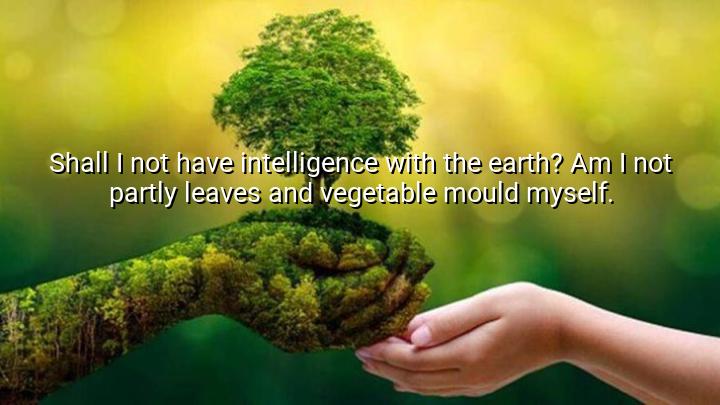




The quote "Shall I not have intelligence with the earth? Am I not partly leaves and vegetable mould myself" by Henry David Thoreau reflects his deep connection to the natural world and his belief in the interconnectedness of humanity and nature. Thoreau is questioning the traditional separation between humans and the earth, suggesting that our intelligence is not just a product of our minds, but is also deeply linked to the earth and the natural elements that make up our existence. By referencing leaves and vegetable mould, he highlights the idea that we, too, are part of the organic and living world around us, and that our wisdom can be drawn from our connection to nature.
Thoreau's question challenges the notion of human superiority over nature and encourages a more holistic understanding of intelligence—one that incorporates empathy, understanding, and respect for the environment. He argues that just as the earth has its own forms of wisdom, so too does humanity, and that our intelligence can be enriched by our relationship with the natural world. This perspective aligns with Thoreau’s broader philosophy of simplicity, self-reliance, and a deep respect for the environment, which he famously explored in his work Walden.
The origin of this quote can be found in Thoreau's writings, which often sought to explore humanity’s relationship with nature. Thoreau spent two years living in the woods near Walden Pond, where he immersed himself in nature to better understand the rhythms of life and the interconnectedness of all living things. His time in nature led him to the conclusion that our intelligence is not separate from the world around us but is instead deeply rooted in it, influenced by the land, the plants, and the cycles of the earth.
Ultimately, Thoreau’s quote encourages us to recognize the intelligence that comes from our relationship with the earth and to appreciate the wisdom that nature offers. It is a call to rethink how we define intelligence, advocating for a broader, more inclusive view that encompasses not just human reasoning, but our connection to the planet and its living systems. By acknowledging that we are partly leaves and vegetable mould, Thoreau reminds us that the earth is not just a resource to be used, but a vital part of our existence and identity.

AAdministratorAdministrator
Welcome, honored guests. Please leave a comment, we will respond soon