

Sell a country?! Why not sell the air, the great sea, as well as the earth? Did not the Great Spirit make them all for the use of his children?
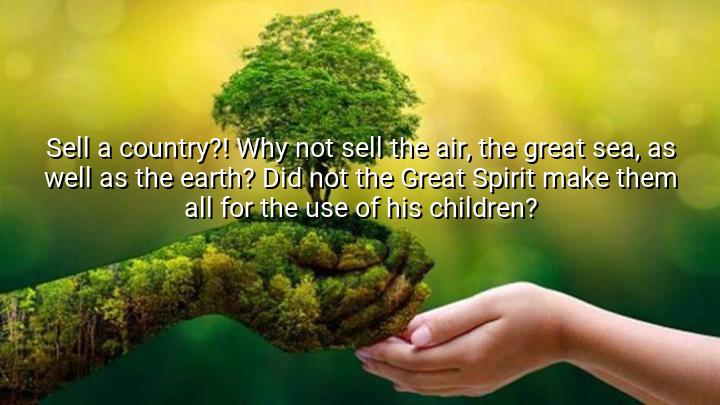




Tecumseh’s quote is a powerful reflection on the ownership and exploitation of land, particularly in the context of the Native American experience. He asks rhetorically whether it is justifiable to sell a country, comparing it to the idea of selling the air, sea, and earth—elements that are meant to be shared by all of humanity. By invoking the Great Spirit, a reference to the creator in Native American belief systems, Tecumseh emphasizes that the land and natural resources were given for the use of all people, not to be commodified or claimed by individuals or governments.
The origin of the quote comes from Tecumseh, a prominent Shawnee leader and warrior in the early 19th century who was a key figure in resisting the forced relocation and encroachment on Native American lands by European settlers. Tecumseh’s opposition to the selling of Native lands and his advocacy for pan-Indian unity are central themes in his leadership. His belief that the earth and its resources were not to be sold or controlled by a few individuals reflects his commitment to protecting Native sovereignty and the sacredness of the land.
In the quote, Tecumseh’s rhetorical question underscores the injustice of treating land as private property that can be bought and sold. He argues that land is a gift from the Great Spirit and should not be subject to the greed or exploitation of settlers and colonizers. His words challenge the idea of privatization of natural resources, positioning the land as something meant to be shared and respected by all people, rather than something to be owned by a few.
In a broader sense, the quote critiques the practice of colonialism and the displacement of indigenous people, where the land is treated as a commodity rather than a sacred space. It also serves as a reminder of the spiritual and cultural connections that indigenous people have with the land, which goes beyond its material value. Tecumseh’s words resonate as a call for the respect of natural resources and a critique of the commodification of the earth, advocating for a more sustainable and inclusive way of thinking about the environment.

AAdministratorAdministrator
Welcome, honored guests. Please leave a comment, we will respond soon