

Schools are not intended to moralize a wicked world, but to impart knowledge and develop intelligence, with only two social aims in mind: prepare to take on one's share in the world's work, and perhaps in addition, lend a hand in improving society, after schooling is done.
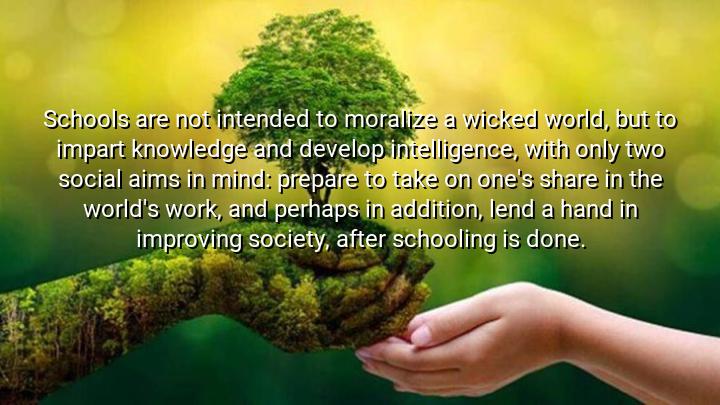




Jacques Barzun's quote emphasizes the primary purpose of schools as institutions of learning, not as vehicles for moralizing or correcting the wickedness of the world. He argues that the true role of education is to impart knowledge and develop intelligence, not to impose specific moral values or attempt to fix societal ills. This viewpoint highlights the distinction between education as an academic pursuit and the expectation for schools to address broader social issues, a task that, according to Barzun, falls outside their core mission.
The quote also suggests that schools have two key social aims: first, to prepare students to participate in the world's work, equipping them with the skills and knowledge necessary to contribute to the economy and society. Second, Barzun acknowledges the possibility that education might inspire students to go beyond their own personal development and, once they complete their schooling, become active in improving society. This reflects the idea that education can foster a sense of social responsibility, though this is seen as an optional, rather than primary, outcome.
Barzun's perspective challenges the notion that schools should act as moral authorities or shape the character of students to conform to a particular vision of good or ethical behavior. Instead, he places the focus squarely on intellectual development and practical preparation for the workforce. The moral and societal roles that individuals take on are, in Barzun’s view, a matter of personal choice, not the responsibility of formal education.
Ultimately, Barzun's quote advocates for a clear separation between education's academic goals and the broader, more complex issues of moral guidance and social change. He believes that schools should focus on preparing students to engage with the world practically and intellectually, while allowing personal conscience and later experiences to shape their contributions to society.

AAdministratorAdministrator
Welcome, honored guests. Please leave a comment, we will respond soon