

Religious speech is extreme, emotional, and motivational. It is anti-literal, relying on metaphor, allusion, and other rhetorical devices, and it assumes knowledge within a community of believers.
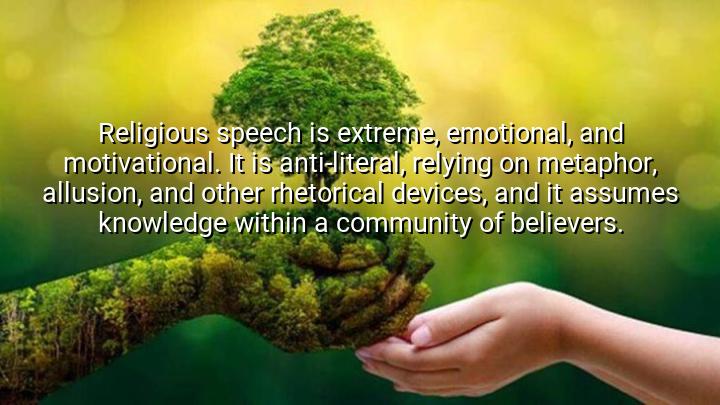




The quote “Religious speech is extreme, emotional, and motivational. It is anti-literal, relying on metaphor, allusion, and other rhetorical devices, and it assumes knowledge within a community of believers.” by Amy Waldman examines the unique character of religious speech and its role in shaping faith communities. Waldman points out that such speech is often emotional and motivational, designed to inspire rather than merely inform. By calling it anti-literal, she highlights how religious expression depends heavily on metaphor, allusion, and symbolic language that communicates meaning beyond the surface level.
The origin of this statement comes from Waldman’s reflections as a novelist and journalist, particularly in her novel The Submission (2011), which explores the cultural and religious tensions in post-9/11 America. Her background in covering religion, politics, and society informed her understanding of how religious rhetoric operates differently from secular speech. Instead of relying on direct or literal meaning, religious communication draws on shared knowledge and traditions within a community of believers, making it deeply contextual.
The meaning of the quote is that religious communication is not meant to be taken as plain instruction but as an interpretive experience. It binds communities together through shared symbols, stories, and values, relying on a collective framework of belief. Religious speech moves hearts and minds by appealing to emotion and imagination, not simply logic. In this way, it becomes a powerful tool for both individual faith and collective identity.
Ultimately, Waldman’s observation underscores the cultural and rhetorical richness of religious discourse. By relying on metaphor and allusion, religious speech transcends literal meaning and points toward deeper truths that can only be fully understood within the context of faith communities. Her insight shows how religion communicates on both a spiritual and social level, shaping how believers see themselves and their place in the world.

AAdministratorAdministrator
Welcome, honored guests. Please leave a comment, we will respond soon