

Poetry is not only dream and vision; it is the skeleton architecture of our lives. It lays the foundations for a future of change, a bridge across our fears of what has never been before.
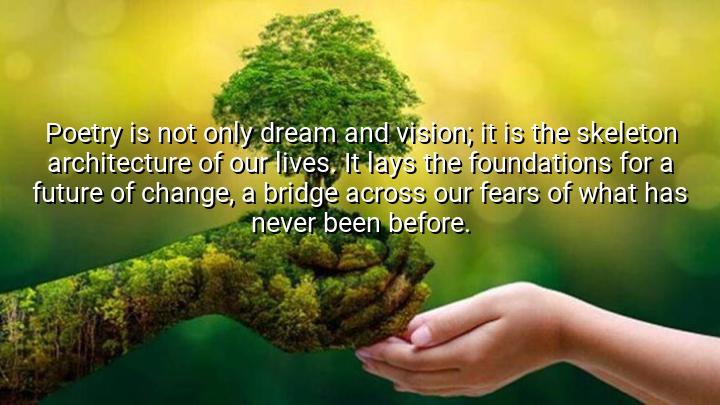




The quote by Audre Lorde, “Poetry is not only dream and vision; it is the skeleton architecture of our lives,” speaks to the deep structural role that poetry plays in human experience. Rather than viewing poetry as merely imaginative or decorative, Lorde presents it as a framework, a foundation upon which we build our thoughts, beliefs, and actions. The phrase “skeleton architecture” evokes the idea that poetry underpins our very being—just as a skeleton gives form and support to a body, poetry gives form to our emotions, identities, and aspirations.
The quote continues, “It lays the foundations for a future of change,” emphasizing poetry’s role as an agent of transformation. Lorde believed that through poetic expression, individuals and communities could confront pain, articulate truths, and imagine radical futures. Poetry becomes a catalyst—not only reflecting the world as it is but also shaping what it might become. It empowers the marginalized to speak and, in doing so, lays groundwork for social change.
The final line, “a bridge across our fears of what has never been before,” reveals poetry’s power to connect us to the unknown. Fear of the unfamiliar can paralyze progress, but poetry offers a path forward—a way to name, explore, and ultimately embrace new possibilities. In Lorde’s vision, poetry functions as a bridge over the emotional and societal gaps that separate the present from a more just and inclusive future.
Audre Lorde, a Black lesbian feminist and poet, often used her work to challenge systems of oppression and to highlight the necessity of using language as a tool of resistance. This quote, drawn from her essays in Sister Outsider, encapsulates her belief that poetry is not a luxury but a necessity—especially for those living at the intersections of identity, struggle, and hope.

DT11A Le Duy Trung
There’s something radical in the idea that poetry lays the foundation for change. We usually associate activism with action, not art. But Lorde seems to argue that the emotional and imaginative groundwork is just as important. Could this mean that cultural change always begins with internal shifts in language and vision? If that’s true, then poetry isn't just expressive—it's political. Do you think that’s a fair interpretation of her message?
TKDang Tuan Khoi
I love this quote, but it makes me wonder—can poetry really help us face the unknown, or does it just provide a kind of comfort? Lorde suggests it’s a bridge over fear, but I’ve always thought of poetry as a mirror, showing us who we already are. Is it both? Or does it depend on how the poem is written or read? I’d be interested in hearing how others use poetry during times of uncertainty.
UGUser Google
This quote made me reflect on how often I overlook poetry as something frivolous or purely emotional. But calling it the ‘architecture of our lives’ forces me to reconsider. Is Lorde saying that poetry shapes how we think and act, like an unseen framework? If so, how does that compare to other art forms or narratives? Why does poetry, in particular, hold that structural power? Is it its precision, rhythm, or emotional resonance?
TMTai Mai
Lorde’s words are beautiful, but I’m curious—can everyone access poetry in this transformative way? For many, poetry feels distant or academic. How do we bridge that gap so it actually becomes part of the 'skeleton' of more people’s lives? Maybe it's not about traditional forms, but about redefining what poetry means in everyday speech, protest, or storytelling. What do you think—does poetry need to evolve to fulfill this vision?
Hhh
This quote resonates deeply with me, especially the idea that poetry is foundational rather than just decorative. But I wonder—how does that play out in real life? Can a poem really spark lasting change, or is its power more emotional and internal? I’d love to hear examples of times when poetry influenced social movements or individual transformation. Is this metaphor about poetry’s structure too idealistic, or is it actually grounded in history?