

Poetic knowledge is born in the great silence of scientific knowledge.
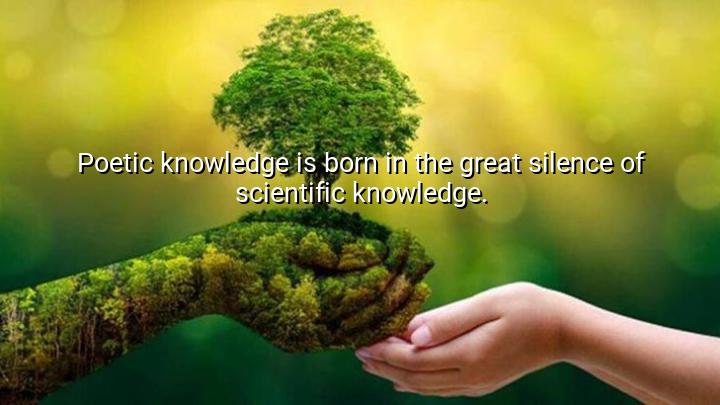




The quote “Poetic knowledge is born in the great silence of scientific knowledge.” is attributed to Aimé Césaire, the Martinican poet, playwright, and politician who was a leading voice of the Négritude movement. At its core, the statement explores the relationship between scientific knowledge and poetic knowledge, suggesting that while science explains the world through logic and analysis, it leaves behind a kind of silence—a space where poetry, imagination, and emotion can arise to fill what science cannot fully capture.
The origin of this idea is rooted in Césaire’s broader philosophy, which sought to reclaim art, language, and imagination as vital aspects of human identity, especially for colonized peoples. As a poet, he recognized the importance of science but also insisted that it could not encompass the fullness of human experience. In the gaps left by rational analysis, poetic expression emerges, offering meaning, beauty, and depth beyond measurable facts. His words reflect both a critique of the limitations of science and a celebration of the complementary power of art.
The meaning of the quote highlights that scientific knowledge gives us clarity, but it often strips the world of mystery and emotion. Poetic knowledge, on the other hand, thrives in this silence, offering insight into the human spirit, creativity, and the unexplainable dimensions of existence. Césaire suggests that the two are not enemies but partners: science provides structure and understanding, while poetry restores wonder, awe, and humanity to what might otherwise seem cold and mechanical.
Ultimately, Césaire’s statement is a call to balance. He reminds us that progress is not only measured by scientific breakthroughs but also by the nourishment of the soul through poetry and imagination. In the silence where science ends, art begins, ensuring that human beings remain whole—embracing both the rational and the poetic dimensions of life.

AAdministratorAdministrator
Welcome, honored guests. Please leave a comment, we will respond soon