

Pessimists are the people who have no hope for themselves or for others. Pessimists are also people who think the human race is beneath their notice, that they're better than other human beings.
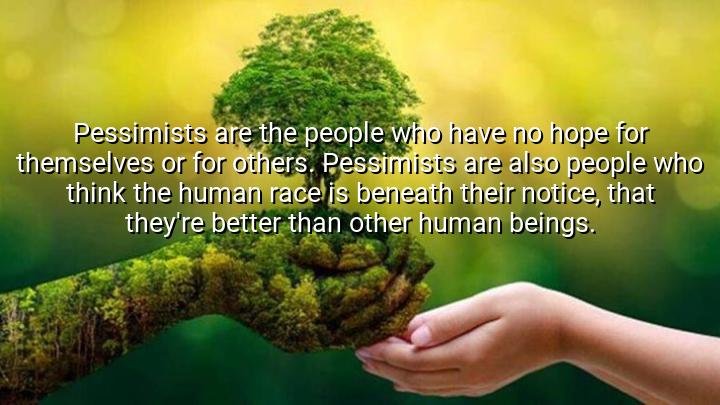




The quote "Pessimists are the people who have no hope for themselves or for others. Pessimists are also people who think the human race is beneath their notice, that they're better than other human beings" by James Baldwin explores the nature of pessimism and its impact on human relationships and society. Baldwin, an influential American writer and activist, often delved into issues of race, identity, and human connection. In this quote, he defines pessimism not just as a lack of hope, but as a belief that both oneself and others are incapable of positive change or improvement, often leading to a sense of superiority over the rest of humanity.
The origin of this quote lies in Baldwin's broader philosophical and social views. Baldwin believed that pessimism often stems from a place of alienation or disillusionment, where individuals lose faith in the potential for growth, both in themselves and in society. His statement criticizes how pessimism can lead to a sense of elitism, where people who have become cynical about the world may also feel disconnected from the struggles and worth of others. For Baldwin, this mindset breeds isolation and contempt, hindering any possibility of meaningful human connection or collective progress.
Baldwin contrasts pessimism with hope and empathy, suggesting that a true understanding of others involves recognizing our shared humanity rather than seeing ourselves as superior or above others. The quote underscores the idea that pessimism is not only an internal struggle but also an outward expression of how one views the rest of the human race. It points to the dangers of becoming so disillusioned with the world that one becomes disconnected from it, both emotionally and morally.
Ultimately, Baldwin's quote challenges us to rethink how we approach optimism, hope, and humanity. He warns that pessimism, when combined with a sense of superiority, can lead to a dangerous disconnection from the collective experience. Rather than distancing oneself from others, he advocates for understanding and embracing the shared struggles and potential for growth that define the human condition.

AAdministratorAdministrator
Welcome, honored guests. Please leave a comment, we will respond soon