

People think it's terribly sad to spend Christmas alone, but it's no sadder, really, than spending any other day alone, is it?
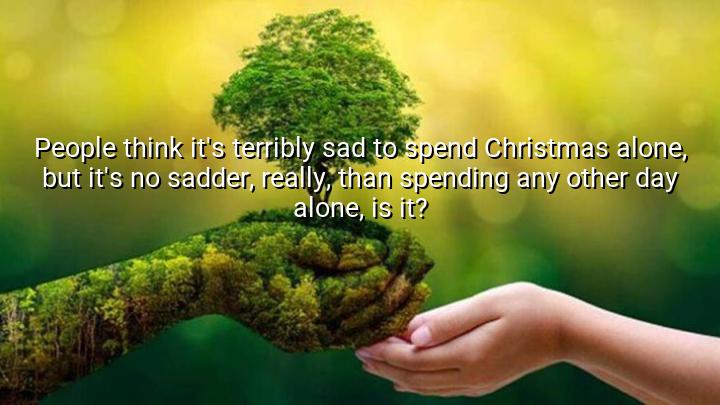




In this quote, Paula Hawkins reflects on the perception of spending Christmas alone, challenging the common belief that it is inherently more sad or lonely than being alone on any other day of the year. She questions the idea that Christmas—a holiday typically associated with family gatherings and celebration—is uniquely difficult when spent in solitude. Hawkins suggests that the emotional weight attached to being alone during the holiday season might be more of a societal expectation rather than a genuine emotional reality.
Hawkins highlights the fact that being alone on any given day, not just Christmas, can evoke feelings of loneliness or isolation. She seems to propose that the experience of solitude is subjective and that, while holidays like Christmas may intensify feelings of being alone, the emotional impact is not necessarily more severe than being alone on other days. In doing so, she challenges the idea that Christmas should hold a special, perhaps exaggerated, significance in terms of loneliness.
This perspective can be seen as a way of normalizing solitude, reminding us that being alone doesn’t always carry the emotional weight that society sometimes attaches to it, particularly around holidays. Hawkins’ comment suggests that personal experience, rather than the collective narrative, determines how we feel about solitude and that the expectation that Christmas should be inherently joyful for everyone may overlook those who experience solitude year-round.
Ultimately, Paula Hawkins’s quote invites us to reconsider how we view loneliness during the holidays. It suggests that while many associate Christmas with togetherness and community, the feeling of being alone is not necessarily amplified by the holiday itself. Instead, the emotional experience of solitude is more about individual context than about the day on the calendar.

AAdministratorAdministrator
Welcome, honored guests. Please leave a comment, we will respond soon