

Patience, that blending of moral courage with physical timidity.
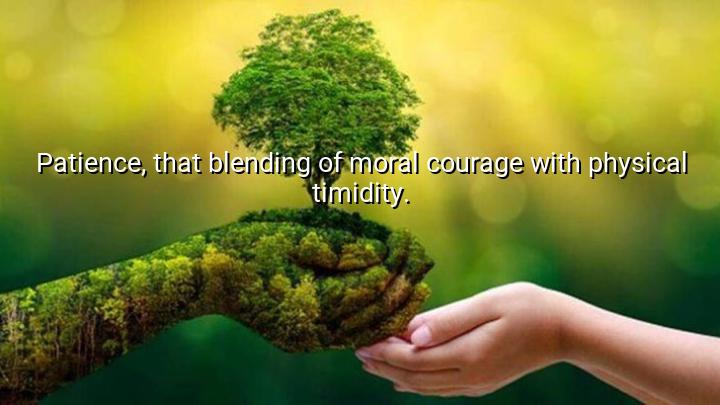




In this quote, Thomas Hardy defines patience as a unique combination of moral courage and physical timidity. Hardy suggests that true patience is not merely about waiting or being passive but involves an active, internal strength. It requires the moral courage to endure challenges or discomfort without reacting impulsively, and physical timidity, in this sense, refers to the restraint from acting hastily or recklessly. Patience, then, becomes a blend of inner resolve and outward restraint, allowing one to endure difficult circumstances with grace.
Hardy’s reference to moral courage points to the inner fortitude needed to endure situations that test our limits. It involves the ability to stay true to one’s values, even in the face of adversity. On the other hand, physical timidity implies the ability to hold back from acting in ways that could be destructive or impulsive. In the context of patience, it is the restraint to not act until the right moment arrives or until the emotions settle.
The quote also highlights how patience is not a passive state of waiting but an active choice to withstand difficulties. It suggests that patience involves a certain mental strength to manage discomfort and the courage to persevere despite challenges, often requiring more effort than immediate action or response. In this way, patience is a form of personal discipline that builds resilience over time.
Ultimately, Hardy’s words suggest that patience is a vital quality, not only because it helps one endure hardship but also because it combines the qualities of restraint, courage, and strength. The quote reminds us that sometimes, the greatest act of courage is not in taking immediate action but in patiently withstanding the trials life presents, waiting for the right time to act.

AAdministratorAdministrator
Welcome, honored guests. Please leave a comment, we will respond soon