

Our task must be to free ourselves by widening our circle of compassion to embrace all living creatures and the whole of nature and its beauty.
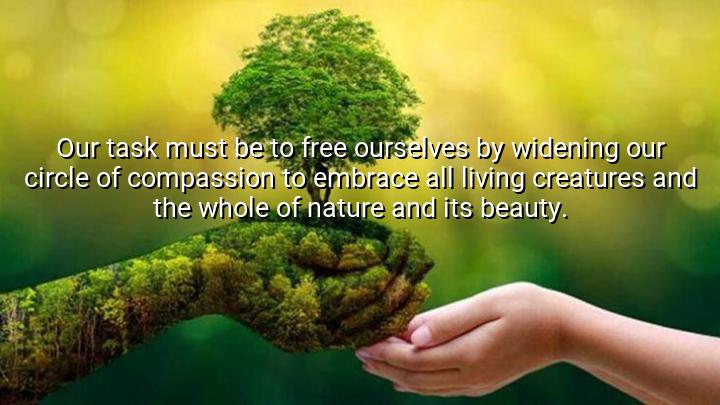




Albert Einstein’s quote, “Our task must be to free ourselves by widening our circle of compassion to embrace all living creatures and the whole of nature and its beauty,” speaks to the importance of expanding our sense of empathy and connection to the world around us. Einstein suggests that in order to achieve true freedom and fulfillment, we must extend our compassion beyond ourselves and even beyond human beings, to include all living creatures and the natural world. The act of widening our circle of compassion allows us to embrace not just humanity, but the entire ecosystem and its inherent beauty.
The quote emphasizes that compassion is a powerful force that has the potential to liberate us, both individually and collectively. By fostering empathy for nature and its inhabitants, we break down the boundaries that often lead to self-centeredness or a limited view of the world. Einstein implies that our moral responsibility is not just toward humans, but to all forms of life, suggesting a deep ethical and spiritual connection between humanity and the environment.
Einstein’s words also highlight the idea that beauty is an intrinsic part of nature, and that by expanding our compassion, we can come to appreciate and protect that beauty. The connection between compassion and beauty suggests that true appreciation of the world is tied to understanding and respecting its interconnectedness. By embracing this broader perspective, we can move toward a more harmonious and sustainable relationship with both the natural world and each other.
The origin of this quote comes from Einstein’s broader worldview, which extended far beyond physics and into social and environmental concerns. Known for his humanitarian efforts and advocacy for peace, Einstein was deeply concerned about the well-being of humanity and the planet. This quote encapsulates his belief in the importance of empathy, social responsibility, and a deeper understanding of our place in the universe—values he carried throughout his life both in his scientific work and his public activism.

AAdministratorAdministrator
Welcome, honored guests. Please leave a comment, we will respond soon