

Our knowledge and all of our ideas are mutually connected; the more complicated they are, the more numerous must be the roads that lead to them and depart from them.
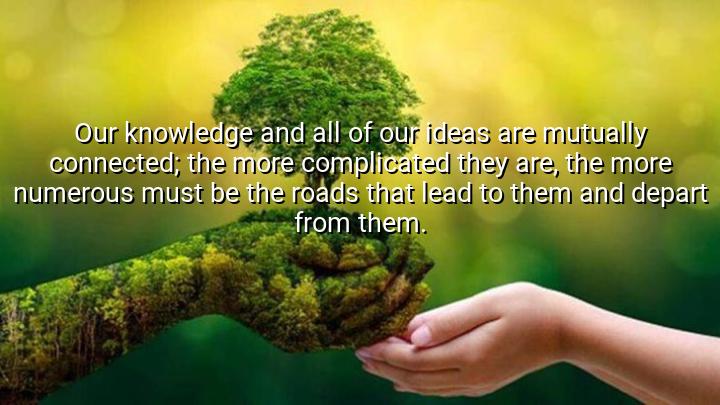




The quote by Cesare Beccaria, "Our knowledge and all of our ideas are mutually connected; the more complicated they are, the more numerous must be the roads that lead to them and depart from them," reflects a profound understanding of the interconnectedness of thought. Beccaria emphasizes that ideas do not exist in isolation; each piece of knowledge is linked to others, forming a complex network of understanding. The more intricate an idea, the more ways there are to approach, explore, and apply it, illustrating the dynamic nature of intellectual inquiry.
By referring to roads that lead to and depart from knowledge, Beccaria uses a metaphor to describe the various paths of reasoning and interpretation that allow humans to comprehend and expand upon complex ideas. This underscores the importance of flexibility, perspective, and exploration in intellectual pursuits. It also suggests that understanding emerges not just from acquiring facts, but from recognizing how those facts and concepts are interrelated.
The origin of this quote comes from Beccaria’s work as an Italian philosopher, criminologist, and economist in the 18th century, during the Enlightenment. He is best known for his writings on law, justice, and rational thought, advocating for reasoned approaches to society and governance. His emphasis on the systematic connection of knowledge reflects the broader Enlightenment belief in rationality, logic, and structured understanding as the foundation of human progress.
Ultimately, Beccaria’s statement highlights the complexity and interdependence of ideas. It reminds us that to truly grasp a concept, one must explore multiple perspectives and connections, appreciating that knowledge is a living network rather than a collection of isolated facts. This perspective encourages critical thinking, creativity, and intellectual curiosity in the pursuit of understanding.

AAdministratorAdministrator
Welcome, honored guests. Please leave a comment, we will respond soon