

Our human compassion binds us the one to the other - not in pity or patronizingly, but as human beings who have learnt how to turn our common suffering into hope for the future.
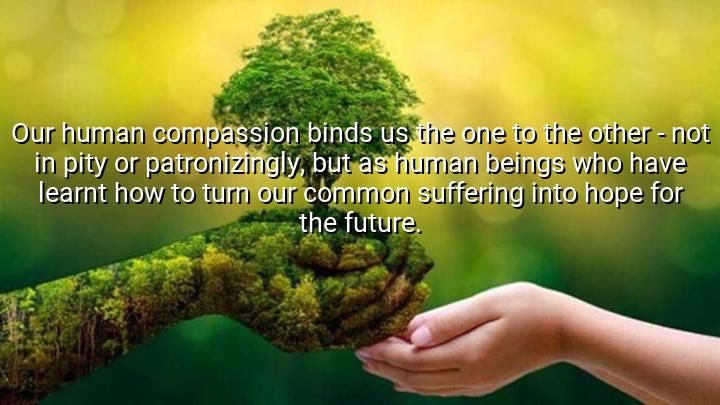




Nelson Mandela’s quote, "Our human compassion binds us the one to the other - not in pity or patronizingly, but as human beings who have learnt how to turn our common suffering into hope for the future," emphasizes the power of empathy and solidarity in the face of adversity. Mandela is pointing out that true compassion is not about feeling sorry for others or looking down on them, but about recognizing our shared humanity. When we understand each other’s struggles and suffering, we can work together to transform those challenges into something positive and hopeful for the future.
The origin of this quote comes from Mandela’s experiences in South Africa, particularly during his fight against apartheid and his time in prison. Throughout his life, Mandela emphasized the importance of unity and the ability of people to come together in the face of common suffering. His belief in the power of compassion as a unifying force led to his work not only as a political leader but as a symbol of forgiveness and reconciliation.
Mandela’s words also suggest that suffering is a shared human experience that can either divide us or bring us closer together. Instead of allowing pain to drive us apart, Mandela encourages us to use it as a source of strength and hope. This process of transforming suffering into hope is what creates a sense of community, where people support one another in meaningful ways rather than out of pity.
Ultimately, this quote serves as a reminder that compassion, when rooted in mutual respect and understanding, has the power to heal and unite. Mandela’s call to turn suffering into hope challenges us to embrace our shared humanity and build a future where empathy and collective action guide our interactions. It is a testament to the strength of the human spirit and our ability to create a better world through kindness and understanding.

AAdministratorAdministrator
Welcome, honored guests. Please leave a comment, we will respond soon