

Only the other world has substance and reality; only good deeds and holy learning have tangible worth.
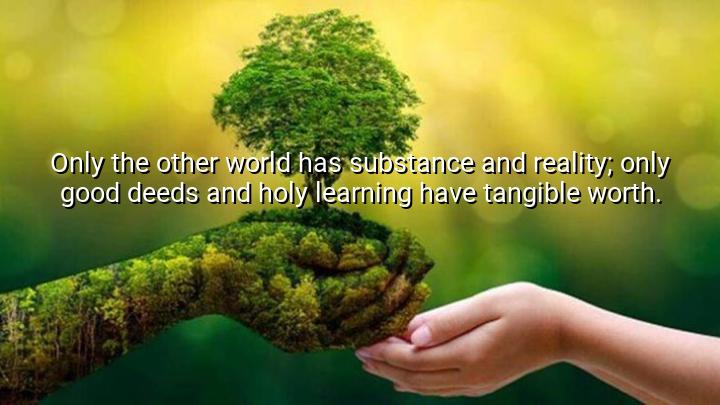




The quote by Abraham Cahan, “Only the other world has substance and reality; only good deeds and holy learning have tangible worth,” emphasizes a spiritual perspective on life. Cahan, a Jewish-American writer and journalist in the late 19th and early 20th centuries, often explored themes of faith, ethics, and the immigrant experience. Here, he suggests that the material world is fleeting and illusory, whereas actions rooted in morality and spiritual knowledge carry lasting value and significance.
By mentioning the "other world," Cahan invokes the concept of an afterlife or spiritual realm, implying that true meaning in life comes from aligning oneself with divine principles rather than temporary worldly pursuits. This reflects a traditional Jewish perspective where righteous behavior and study of sacred texts are considered essential to living a life of purpose and achieving eternal merit.
The emphasis on good deeds highlights the ethical dimension of human existence. Actions that benefit others or contribute positively to society are seen as tangible expressions of virtue, and Cahan suggests they are more enduring than material success. Similarly, holy learning refers not just to academic study but to spiritual cultivation, reinforcing the idea that knowledge of moral and sacred truths is a key source of lasting worth.
In essence, Cahan’s quote serves as a reminder to prioritize ethics, spiritual growth, and service over material concerns. It is a reflection of his broader worldview, which merges the practical challenges of immigrant life with a deep commitment to faith, righteousness, and the pursuit of higher values that transcend the temporary realities of the physical world.

AAdministratorAdministrator
Welcome, honored guests. Please leave a comment, we will respond soon