

One of the dreams of Zionism was to be a bridge. Instead, we are creating exclusion between the East and the West instead of creating bridges; we are contributing to the conflict between East and West by our stupid desire to have more.
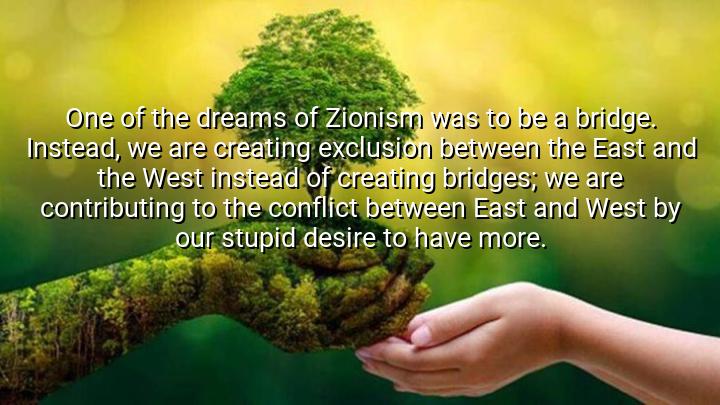




A. B. Yehoshua’s quote reflects his critique of the modern state of Zionism and its evolving role in the world. He begins by referencing one of the original dreams of Zionism, which was to act as a bridge—a connecting force between the East and the West. The idea behind this vision was to foster unity and understanding between two distinct cultural and geopolitical realms. However, Yehoshua argues that, instead of fulfilling this purpose, Zionism and the Israeli state have contributed to greater exclusion and division, especially in the context of the ongoing conflict between the Middle East and the West.
Yehoshua further critiques the desire for more—a reference to the ambition for territorial expansion, political power, and economic growth. He believes that this stupid desire for more leads to intensified conflict and division rather than cooperation and peace. By focusing on gaining more land, resources, or power, the Israeli state (and, by extension, its supporters) may inadvertently fuel tensions between the East and the West, pushing the world further apart rather than encouraging dialogue or mutual understanding. This, for Yehoshua, represents a tragic departure from the original Zionist ideals.
The origin of this quote can be traced to Yehoshua’s longstanding role as a writer and public intellectual in Israel. As a supporter of Zionism in its early days, Yehoshua has critiqued the way the movement has evolved, especially its impact on the Israeli-Palestinian conflict and the broader Middle Eastern geopolitics. He is known for his critical perspective on the policies of the Israeli government, advocating for peace and reconciliation rather than expansionism or militarization.
Ultimately, Yehoshua’s quote is a call for reflection on the direction of Zionism and the role of Israel in fostering global unity. He laments that the dream of being a bridge between cultures has been replaced by a reality where division and conflict dominate. His message is one of self-awareness, urging both Israelis and the broader international community to reconsider their actions and their consequences in terms of global peace and understanding.

AAdministratorAdministrator
Welcome, honored guests. Please leave a comment, we will respond soon