

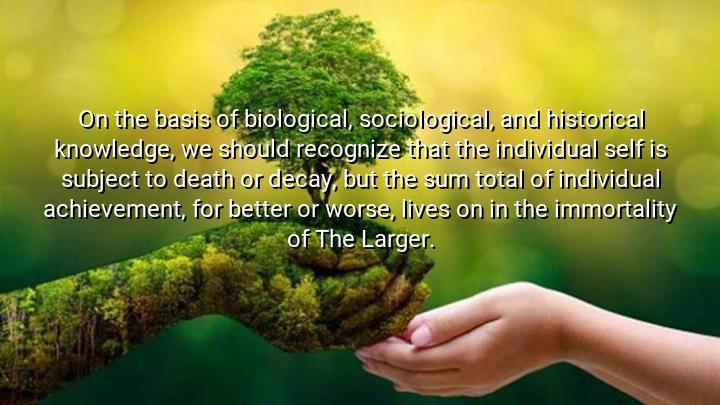
On the basis of biological, sociological, and historical knowledge, we should recognize that the individual self is subject to death or decay, but the sum total of individual achievement, for better or worse, lives on in the immortality of The Larger.
On the basis of biological, sociological,
On the basis of biological, sociological, and historical knowledge, we should recognize that the individual self is subject to death or decay, but the sum total of individual achievement, for better or worse, lives on in the immortality of The Larger.

On the basis of biological, sociological,
On the basis of biological, sociological, and historical knowledge, we should recognize that the individual self is subject to death or decay, but the sum total of individual achievement, for better or worse, lives on in the immortality of The Larger.
On the basis of biological, sociological,
On the basis of biological, sociological, and historical knowledge, we should recognize that the individual self is subject to death or decay, but the sum total of individual achievement, for better or worse, lives on in the immortality of The Larger.
On the basis of biological, sociological,
On the basis of biological, sociological, and historical knowledge, we should recognize that the individual self is subject to death or decay, but the sum total of individual achievement, for better or worse, lives on in the immortality of The Larger.
On the basis of biological, sociological,
On the basis of biological, sociological, and historical knowledge, we should recognize that the individual self is subject to death or decay, but the sum total of individual achievement, for better or worse, lives on in the immortality of The Larger.
On the basis of biological, sociological,

The quote by Hu Shih—“On the basis of biological, sociological, and historical knowledge, we should recognize that the individual self is subject to death or decay, but the sum total of individual achievement, for better or worse, lives on in the immortality of The Larger”—emphasizes the transience of the individual versus the enduring impact of human achievement. Hu Shih suggests that while people themselves are mortal, their contributions to society, culture, and knowledge can persist and influence future generations, forming a collective legacy.

A central idea in the quote is that individual actions gain significance through their broader impact. Hu Shih highlights that personal accomplishments, whether in science, art, governance, or social reform, become part of a larger human narrative. Even though individuals eventually pass away, their achievements contribute to the continuity and development of civilization.

The origin of this quote comes from Hu Shih, a Chinese philosopher, diplomat, and influential scholar in the early 20th century, known for advocating pragmatism, educational reform, and cultural modernization. Hu Shih often reflected on the intersection of individual responsibility and collective human progress, emphasizing that meaningful contributions extend beyond the lifespan of the individual.

Ultimately, the quote conveys that mortality does not negate lasting influence. Hu Shih underscores that while the self is finite, the immortality of human achievement lies in its contribution to the larger society, inspiring future generations and shaping the ongoing course of human knowledge and culture.

Hu Shih
Hu Shih

Chinese - Philosopher December 17, 1891 - February 24, 1962

Have 0 Comment On the basis of biological, sociological,

AAdministratorAdministrator

Welcome, honored guests. Please leave a comment, we will respond soon

Reply.
Information sender
Leave the question
Click here to rate
Information sender
0.15773 sec| 2548.664 kb