

Now all the knowledge and wisdom that is in creatures, whether angels or men, is nothing else but a participation of that one eternal, immutable and increased wisdom of God.
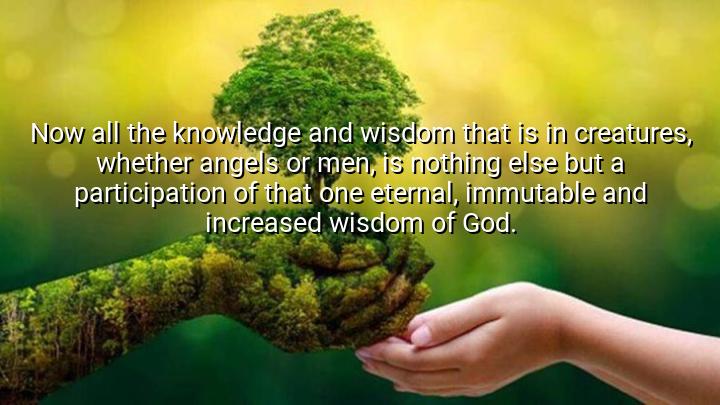




The quote, "Now all the knowledge and wisdom that is in creatures, whether angels or men, is nothing else but a participation of that one eternal, immutable and increased wisdom of God," by Ralph Cudworth, emphasizes a theological perspective on the origin of knowledge and wisdom. Cudworth asserts that all intellectual and moral insight in humans or angels is not independent but derives from and reflects the eternal wisdom of God. This highlights the concept that true understanding is ultimately rooted in the divine and that all finite beings merely participate in this greater wisdom.
Ralph Cudworth (1617–1688) was an English philosopher and theologian, associated with the Cambridge Platonists, a group that sought to reconcile reason, religion, and morality. His writings often explore the metaphysical nature of truth, intellect, and virtue, emphasizing the connection between human knowledge and the divine. This quote reflects his view that wisdom is not merely a human achievement but a reflection of God’s immutable and perfect intellect.
The statement underscores the participatory nature of knowledge and wisdom. According to Cudworth, humans and angels acquire insight not as isolated creators but as participants in the divine order, implying that all meaningful learning and moral understanding are dependent on their connection to God. This reinforces a worldview in which intellect and morality are intertwined with spirituality and the divine source of all truth.
Ultimately, the quote encourages reflection on the origin and purpose of knowledge. It suggests that acquiring wisdom is not only a personal endeavor but also a spiritual alignment with God’s eternal intellect. Cudworth’s perspective highlights the interplay between human reason and divine perfection, reminding us that all true understanding ultimately points beyond ourselves to a higher, eternal source.

AAdministratorAdministrator
Welcome, honored guests. Please leave a comment, we will respond soon