

Not all intelligence can be artificial now, so if we make a mistake, the consequences are no longer simply located within an institution or a national culture.
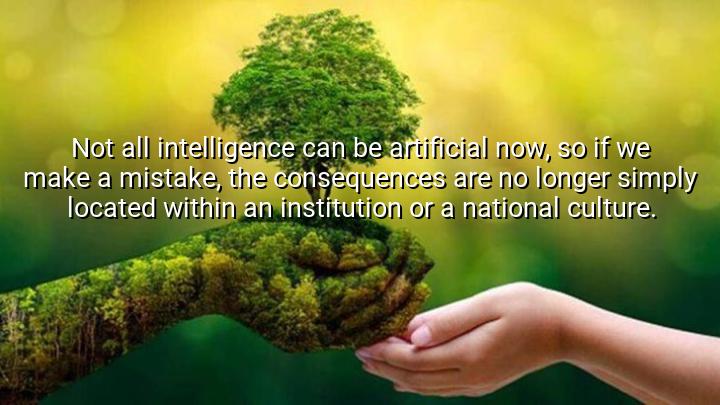




William Irwin Thompson’s quote addresses the limitations of artificial intelligence and its broader impact on society. By saying that "not all intelligence can be artificial now," Thompson suggests that despite the advancements in technology, there remains a significant gap between human and machine intelligence. The statement points to the idea that human intelligence, with its emotional, ethical, and intuitive elements, cannot be fully replicated by AI systems.
Thompson further notes that if a mistake is made in the development or application of artificial intelligence, the consequences are no longer confined to a single institution or national culture. This emphasizes the global nature of technological developments, where a flaw or failure in AI could have far-reaching effects that transcend national borders and sectors. The consequences of AI-driven errors could ripple through global systems, affecting industries, governments, and societies in ways that are difficult to predict or control.
As a scholar and cultural critic, Thompson’s work often explored the intersections of technology, society, and human nature. His quote reflects his broader concerns about the increasing reliance on technology and the loss of human agency in critical decisions. He implies that the consequences of AI-related mistakes are no longer isolated but have the potential to disrupt interconnected global systems.
Ultimately, Thompson’s quote serves as a cautionary reminder of the risks associated with advancing technologies like artificial intelligence. While AI offers vast potential, its integration into the fabric of society brings complexities that extend beyond traditional boundaries of responsibility and control. The quote urges us to think about the ethical and global ramifications of technological progress and to consider how mistakes in these fields might affect the world at large.

AAdministratorAdministrator
Welcome, honored guests. Please leave a comment, we will respond soon