

No one wants to die. Even people who want to go to heaven don't want to die to get there. And yet death is the destination we all share. No one has ever escaped it. And that is as it should be, because Death is very likely the single best invention of Life. It is Life's change agent. It clears out the old to make way for the new.
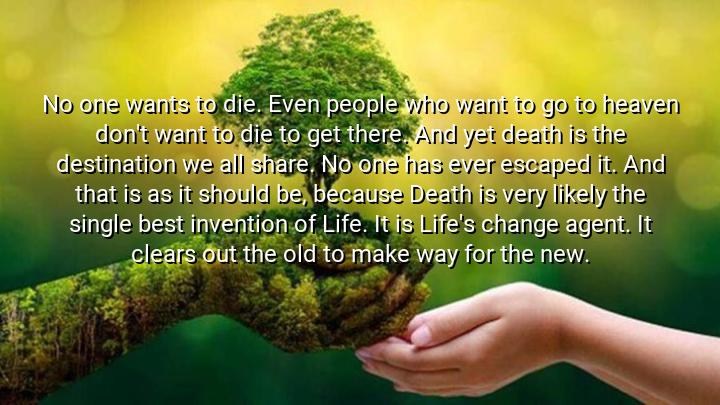




The quote “No one wants to die. Even people who want to go to heaven don't want to die to get there. And yet death is the destination we all share. No one has ever escaped it. And that is as it should be, because Death is very likely the single best invention of Life. It is Life's change agent. It clears out the old to make way for the new.” by Steve Jobs explores the universal inevitability of death and its profound role in the cycle of life. Jobs acknowledges the natural human reluctance to face death, even among those with spiritual beliefs about an afterlife. Despite this fear, he emphasizes that death is a shared and unavoidable fate for everyone, which serves a vital purpose.
Steve Jobs, co-founder of Apple Inc., was known for his philosophical reflections on life and mortality. This quote reflects his belief that death is not merely an end, but a necessary and even beneficial change agent in the natural order. By clearing away the old, death makes space for new growth and innovation, whether in nature, society, or individual lives. Jobs sees death as an essential part of life’s constant evolution and renewal.
The origin of this quote can be traced to Jobs’s 2005 commencement address at Stanford University, where he spoke candidly about his experience with illness and the importance of embracing life’s uncertainties. His words encourage acceptance of death as a motivator to live fully and to appreciate the transient nature of existence. By framing death as life’s “best invention,” Jobs reframes it from something to fear into a catalyst for creativity and transformation.
Ultimately, the quote is a powerful reminder of the interconnectedness of life and death. Jobs’s perspective inspires a deeper understanding of mortality, urging people to see death as part of a larger cycle that drives growth and change. His message encourages embracing life’s impermanence with courage and purpose.

AAdministratorAdministrator
Welcome, honored guests. Please leave a comment, we will respond soon