

Never lose an opportunity of seeing anything beautiful, for beauty is God's handwriting.
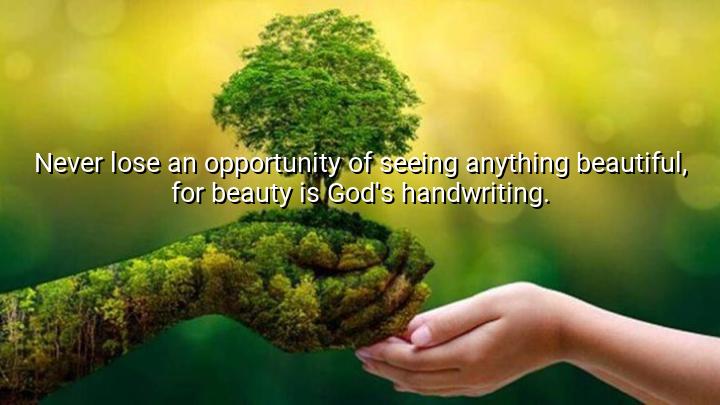




In the quote, "Never lose an opportunity of seeing anything beautiful, for beauty is God's handwriting," Ralph Waldo Emerson emphasizes the profound spiritual and philosophical importance of beauty in our lives. He urges us to remain attentive and open to the world around us, suggesting that every moment of beauty—whether in nature, art, or human connection—is a direct expression of the divine. Referring to beauty as "God's handwriting" portrays it as a sacred signature, a visible and intimate expression of divine presence woven into the fabric of everyday life.
This quote reflects Emerson’s belief in transcendentalism, a philosophical movement that emphasized the inherent goodness of people and nature, as well as the spiritual connection between humanity and the natural world. For Emerson, beauty was not a superficial or fleeting quality, but a revelation of deeper truth—something that connects us to God, truth, and the universe. By recognizing beauty, we are essentially tuning into a greater spiritual awareness.
The origin of this quote can be traced to Emerson's essays and lectures, particularly those concerning nature, aesthetics, and the divine in the everyday. As a 19th-century American philosopher and writer, Emerson often encouraged individuals to seek truth and insight not solely in books or institutions, but in the natural world and in personal intuition. His writings suggest that beauty is a vital force, capable of inspiring the soul and grounding us in a deeper appreciation of life’s mysteries.
Ultimately, Emerson's message is a call to mindfulness and gratitude. By pausing to notice and appreciate beauty—whether in a flower, a sunset, or a kind gesture—we are acknowledging the divine spark present in the world. In doing so, we not only enrich our own lives but also align ourselves with a greater universal harmony.

AAdministratorAdministrator
Welcome, honored guests. Please leave a comment, we will respond soon