

Natural life, lived naturally as it is lived in the countryside, has none of that progress which is the base of happiness. Men and women in rural communities can be compared to a spring that rises out of a rock and spreads in irregular ever-widening circles. But the general principle is static.
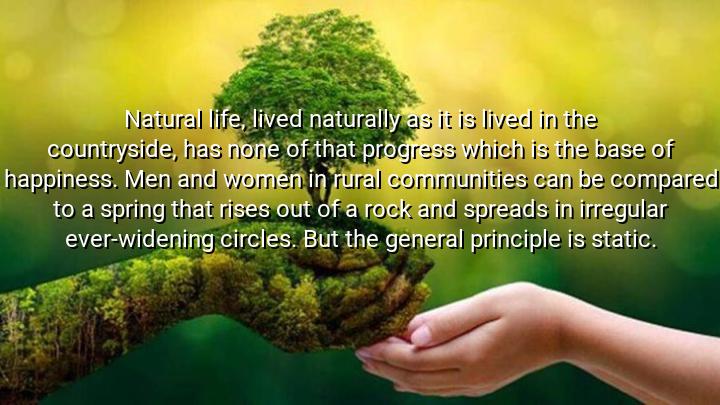




The quote by Patrick Kavanagh — "Natural life, lived naturally as it is lived in the countryside, has none of that progress which is the base of happiness. Men and women in rural communities can be compared to a spring that rises out of a rock and spreads in irregular ever-widening circles. But the general principle is static" — contrasts the simplicity of rural life with the concept of progress often associated with urban or modern life. Kavanagh suggests that life in the countryside is rooted in tradition and nature, where routines and values remain relatively unchanged. While this lifestyle can bring a sense of peace and connection to the earth, it lacks the dynamic progress that he believes is essential for happiness.
Kavanagh, an Irish poet known for his reflections on rural life and its complexities, points out that the people in rural communities, like a spring rising from a rock, create a life that is self-contained and connected to the rhythms of nature. This kind of life spreads outwards, much like the ripples from a spring, but its growth is slow and irregular. The static nature of rural life, though steady and rooted, lacks the forward momentum that drives modern societies and gives individuals a sense of achievement and progress.
The poet’s description of rural life as static also implies that it is resistant to change. Unlike urban life, where constant innovation and advancement fuel the quest for happiness, life in the countryside is governed by cycles that don’t necessarily lead to significant growth or development. While this might bring stability and comfort, it doesn’t offer the same kind of progress that many associate with fulfillment, where individuals are always striving for something new or better.
In essence, Kavanagh’s quote highlights the tension between the static nature of rural life and the dynamic force of progress. While the countryside offers a simpler, more connected existence, it lacks the constant movement and pursuit of change that some believe are essential to achieving true happiness. The quote invites reflection on whether progress is necessary for fulfillment, or if a more grounded, natural life can be equally valuable in its own way.

AAdministratorAdministrator
Welcome, honored guests. Please leave a comment, we will respond soon