

Myths are public dreams, dreams are private myths.
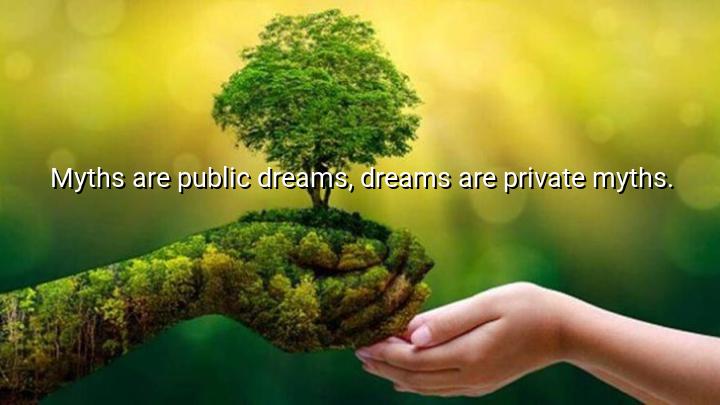




The quote by Joseph Campbell, "Myths are public dreams, dreams are private myths," highlights the deep connection between the concepts of myth and dreams. Campbell suggests that myths, the traditional stories and beliefs shared by societies, can be seen as collective dreams that reflect the unconscious desires, fears, and ideals of a culture. On the other hand, dreams are personal, unique experiences that emerge from the individual psyche but carry similar symbolic significance as myths. Essentially, both myths and dreams are expressions of the human subconscious, just on different scales—one public and one private.
The origin of this quote comes from Campbell’s work in mythology and comparative religion, where he explored how myths reflect universal human experiences and themes. As a scholar, Campbell studied how the stories told across cultures were rooted in common human emotions, struggles, and aspirations. He saw both myths and dreams as tools for understanding the human condition and how we make sense of our experiences, whether on a personal or cultural level.
By saying "Myths are public dreams," Campbell implies that these shared stories serve as a way for societies to process collective experiences and wisdom, much like how dreams help individuals make sense of their inner worlds. He flips this by suggesting that dreams, though personal, carry symbolic meanings that resonate with the same archetypes and themes found in myths, making them similarly meaningful. This perspective encourages us to view both myths and dreams as integral to our understanding of identity, culture, and human experience.
Ultimately, Campbell’s quote bridges the gap between the individual and the collective, showing how dreams and myths both function as vital expressions of the unconscious mind. Whether in the form of a public myth or a private dream, these stories serve to connect us to deeper truths about ourselves and the world around us, providing meaning and guidance in ways that transcend time and culture.

AAdministratorAdministrator
Welcome, honored guests. Please leave a comment, we will respond soon