

My long struggles as a soldier of the Chinese Revolution have forced me to realize the necessity of facing hard facts. There will be neither peace, nor hope, nor future for any of us unless we honestly aim at political, social and economic justice for all peoples of the world, great and small.
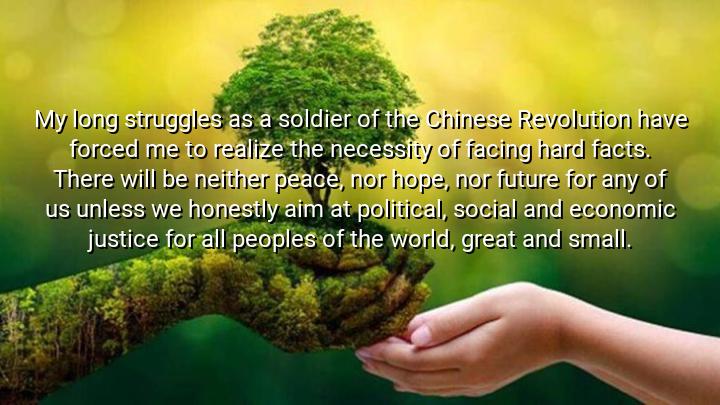




The quote "My long struggles as a soldier of the Chinese Revolution have forced me to realize the necessity of facing hard facts. There will be neither peace, nor hope, nor future for any of us unless we honestly aim at political, social, and economic justice for all peoples of the world, great and small" by Chiang Kai-shek reflects his understanding of the harsh realities of war and the importance of justice in achieving lasting change. Chiang’s experiences as a key figure in the Chinese Revolution led him to confront the difficult truths about the future of his country and the world, emphasizing that only through equity and fairness can true peace and hope be achieved.
Chiang emphasizes that the vision for a better future must include justice on all levels—political, social, and economic—for every group of people, regardless of their size or influence. He believed that the struggle for justice was not just a local or national issue but a global one, where the well-being of all nations, both powerful and small, must be considered in the pursuit of a harmonious world. This call to action reflects his commitment to a broader, more inclusive approach to creating a better future for humanity.
The notion of facing hard facts suggests that Chiang understood the difficult and often uncomfortable realities that must be confronted in order to make progress. The long struggle he faced as a soldier taught him that achieving peace requires acknowledging the inequalities and injustices that persist in society. Without addressing these core issues, there can be no real progress or hope for a stable, fair, and prosperous future.
In a broader historical context, Chiang Kai-shek’s words reflect the challenges faced by revolutionary leaders in seeking not only political change but also the creation of a more just society. His experiences in the Chinese Revolution and his time as the leader of the Republic of China shaped his belief that lasting peace and a hopeful future could only be achieved through the pursuit of comprehensive justice for all people.

AAdministratorAdministrator
Welcome, honored guests. Please leave a comment, we will respond soon