

My interest was always to do interdisciplinary work with space. I thought of architecture as one strand in a multimedia practice.
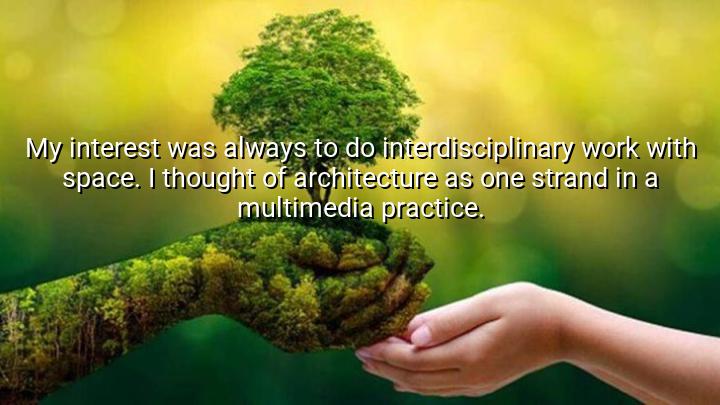




Elizabeth Diller’s quote — "My interest was always to do interdisciplinary work with space. I thought of architecture as one strand in a multimedia practice." — reflects a deep commitment to blending artistic disciplines rather than remaining confined to a single field. By emphasizing interdisciplinary work, Diller reveals a desire to fuse fields such as visual art, sound, film, and technology into her exploration of spatial environments. Her work often challenges conventional architectural boundaries, treating space not only as a built environment but as a conceptual medium open to narrative, performance, and transformation.
The notion of architecture as merely one “strand” in a broader multimedia practice reveals Diller’s ambition to deconstruct traditional hierarchies in creative production. Instead of seeing architecture as the dominant discipline, she integrates it alongside others, creating hybrid experiences that resist categorization. This perspective is rooted in her background and education during a time when critical theory, postmodernism, and experimental media were reshaping the arts.
Elizabeth Diller, co-founder of the firm Diller Scofidio + Renfro, came to prominence in the 1980s and 1990s by crafting projects that blurred the lines between installation art and architecture. Her early works — including performance-based installations and speculative design pieces — embodied her belief that architecture could be performative, sensorial, and discursive. This orientation continues in her later projects like the High Line in New York, where urban space becomes a platform for public engagement and aesthetic dialogue.
Ultimately, this quote highlights Diller’s philosophy that creative practice should not be siloed. It champions a mode of working where space is not merely built but experienced, questioned, and reimagined through the lens of multiple media. Her legacy lies not just in physical structures, but in the ideas and interactions they provoke.

AAdministratorAdministrator
Welcome, honored guests. Please leave a comment, we will respond soon