

Most people say that it is the intellect which makes a great scientist. They are wrong: it is character.
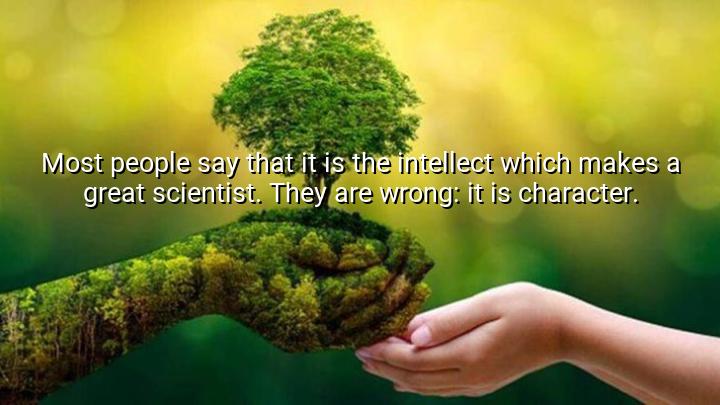




The quote "Most people say that it is the intellect which makes a great scientist. They are wrong: it is character." by Albert Einstein challenges the common belief that intellectual ability is the most important quality for success in science. While intellect, or intellectual ability, is certainly valuable, Einstein emphasizes that character—traits like curiosity, perseverance, ethical responsibility, and resilience—is what truly drives scientific discovery. According to Einstein, it is not simply raw intelligence, but the deeper qualities of character that enable a scientist to approach problems with dedication and integrity.
Einstein’s assertion points to the fact that being a great scientist requires more than just knowing facts or having a high IQ. It involves the ability to deal with setbacks, to maintain an open mind, and to pursue knowledge with a sense of purpose and ethics. A scientist’s character, including qualities such as honesty, creativity, and the willingness to ask difficult questions, plays a crucial role in pushing the boundaries of scientific progress.
The origin of this quote is tied to Einstein’s own life and work, where he valued curiosity, persistence, and a moral compass as critical elements of scientific achievement. Throughout his career, he often expressed the importance of a strong sense of personal responsibility, and how scientific breakthroughs often arise from the character-driven pursuit of truth rather than merely technical ability. This perspective comes from Einstein’s own experiences, which included challenging the scientific establishment and pursuing ideas that initially seemed unconventional or improbable.
In essence, Einstein’s quote serves as a reminder that scientific achievement is not just about intelligence, but about the character that shapes how we approach and solve problems. It highlights the importance of qualities like perseverance, curiosity, and integrity in shaping true scientific innovation and progress. For Einstein, these traits were just as, if not more, important than intellectual brilliance in making lasting contributions to science.

AAdministratorAdministrator
Welcome, honored guests. Please leave a comment, we will respond soon