

Money is human happiness in the abstract; he, then, who is no longer capable of enjoying human happiness in the concrete devotes himself utterly to money.
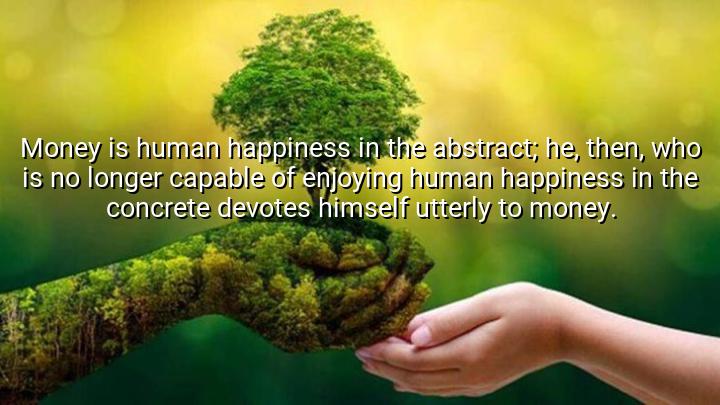




Arthur Schopenhauer’s quote, "Money is human happiness in the abstract; he, then, who is no longer capable of enjoying human happiness in the concrete devotes himself utterly to money," explores the relationship between material wealth and genuine well-being. Schopenhauer suggests that for some individuals, when they are no longer able to experience true happiness from meaningful, real-life experiences or relationships, they shift their focus entirely to the pursuit of money. In this sense, money becomes a substitute for more substantive forms of happiness, taking on an abstract, intangible quality.
The term abstract here refers to something that is conceptual or detached from reality. Schopenhauer contrasts this with concrete happiness, which is grounded in lived experiences, personal connections, and intrinsic satisfaction. For Schopenhauer, true happiness is found not in the accumulation of wealth but in authentic experiences that fulfill a person’s emotional and spiritual needs. When someone loses touch with these sources of happiness, they may become fixated on material wealth as a way to fill the void.
Schopenhauer's view reflects his broader philosophy, which often emphasized the futility of materialism and the suffering that results from desire and attachment to external things. He believed that the pursuit of money could be a form of escapism for those who no longer find joy in the simple pleasures of life. This obsession with wealth, according to Schopenhauer, represents a misguided attempt to achieve happiness, as it is not grounded in the deeper, more fulfilling aspects of human existence.
The origin of this quote lies in Schopenhauer’s examination of human nature and his pessimistic view of life. He argued that the human condition is filled with suffering, and many people turn to superficial distractions, like the pursuit of wealth, in an attempt to escape that suffering. This quote serves as a critique of the modern tendency to prioritize material success over more meaningful, fulfilling experiences that lead to genuine happiness.

AAdministratorAdministrator
Welcome, honored guests. Please leave a comment, we will respond soon