

Men who live valiantly and die nobly have a strength and a courage from the eternal Father.
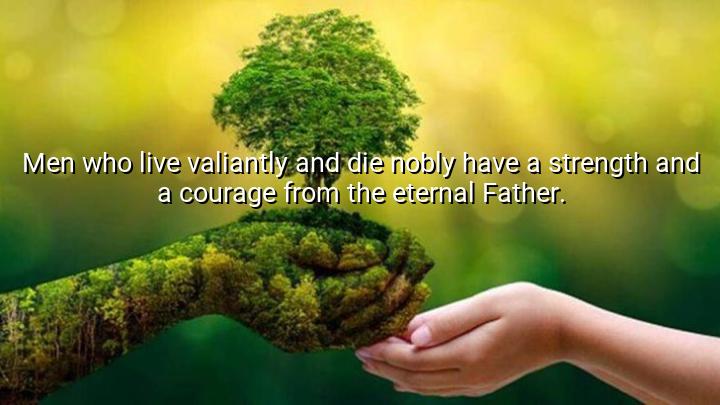




Josephus Daniels' quote, "Men who live valiantly and die nobly have a strength and a courage from the eternal Father," emphasizes the belief that true bravery and honor in life and death come from a higher power, often symbolized as the eternal Father, which can be interpreted as God. Daniels suggests that those who live with courage and integrity, facing challenges with valor and nobility, are empowered by divine strength. This perspective ties moral and physical courage to spiritual guidance and support, implying that their actions reflect a deeper, divine purpose.
The words "valiantly" and "nobly" are key to understanding the kind of life Daniels is referring to—one that involves facing adversity with dignity and honor, and making sacrifices for the greater good. The idea that these individuals draw their strength and courage from a higher source suggests that their virtues are not just human traits but are inspired or sustained by divine intervention. For Daniels, the courage to live well and the bravery to die honorably are connected to a sense of divine purpose.
Daniels’ quote speaks to a broader religious and moral viewpoint, where courage and strength are not merely personal qualities but are seen as part of a larger, spiritual framework. This view reflects the importance of faith in shaping a person’s character, particularly in moments of hardship or sacrifice. The strength drawn from the eternal Father highlights the idea that individuals are not alone in their struggles, and that faith offers them the resilience to face life's toughest challenges.
The origin of this quote likely stems from Daniels’ own experiences and beliefs. As a prominent American public figure and a devout man, Daniels often referenced moral and religious values in his work. His role as a statesman, particularly during his tenure as Secretary of the Navy, would have given him ample opportunity to reflect on the nobility and courage required of men in times of war and peace. The quote reflects his belief in the connection between spiritual strength and human courage.

AAdministratorAdministrator
Welcome, honored guests. Please leave a comment, we will respond soon