

Men need knowledge in order to overpower their passions and master their prejudices.
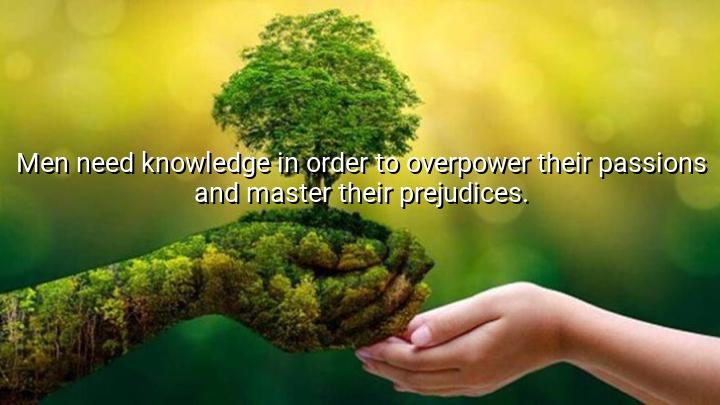




Dorothea Dix’s quote emphasizes the transformative role of knowledge in shaping human character and behavior. By stating that men need knowledge to overpower their passions and master their prejudices, she highlights education and understanding as tools for self-control and moral growth. Without knowledge, people are more likely to be ruled by unchecked emotions or biased views, but with it, they gain the ability to act with reason, fairness, and wisdom.
The origin of this quote can be linked to Dix’s lifelong work as a social reformer and advocate for the mentally ill in the 19th century. Throughout her efforts to establish more humane treatment for patients in asylums, she witnessed firsthand how ignorance and prejudice fueled mistreatment and neglect. Her belief in the power of knowledge reflects her conviction that progress in society depends on overcoming fear and bias through education and enlightened thinking.
The meaning also extends to Dix’s broader vision of social reform. She understood that passion without guidance can lead to destructive outcomes, while prejudice entrenches injustice. Knowledge, by contrast, equips individuals to rise above instinctive reactions and entrenched biases, allowing them to approach others with compassion and understanding. This aligns with her advocacy for policies based on reason rather than cruelty or indifference.
Ultimately, Dix’s statement reflects her faith in the moral and civilizing force of knowledge. She believed that education was not only about intellectual development but also about cultivating a just and humane society. By encouraging individuals to temper their passions and challenge their prejudices, Dix argued that knowledge could become the foundation for both personal integrity and collective progress.

AAdministratorAdministrator
Welcome, honored guests. Please leave a comment, we will respond soon