

Many people make the mistake of confusing information with knowledge. They are not the same thing. Knowledge involves the interpretation of information. Knowledge involves listening.
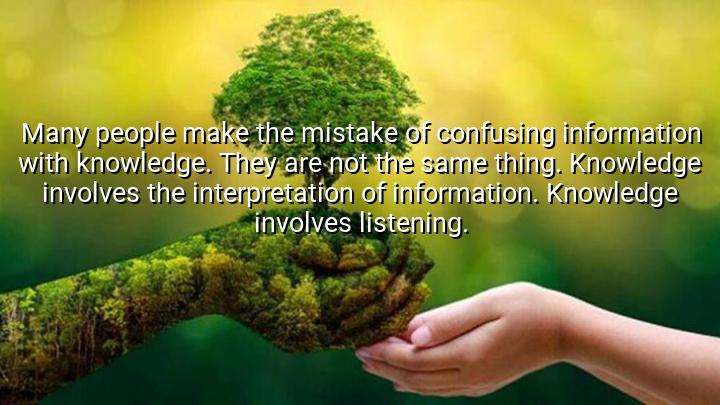




The quote by Henning Mankell highlights the important distinction between information and knowledge. He points out that while many people assume having access to information automatically equates to being knowledgeable, the two are fundamentally different. Information is raw data or facts, whereas knowledge requires understanding, context, and meaningful interpretation.
Mankell emphasizes that knowledge involves the interpretation of information, meaning that one must critically analyze, synthesize, and apply the information in order to truly understand it. Without reflection or thoughtful consideration, information remains superficial, lacking the depth and insight necessary for informed decision-making or problem-solving.
The quote also underscores the role of listening in acquiring knowledge. By paying attention to others, considering different perspectives, and actively engaging with ideas, individuals transform mere information into actionable and meaningful knowledge. This process highlights the relational and interactive aspect of learning, where understanding emerges not just from data but from engagement and reflection.
Originating from Henning Mankell, a Swedish author and social commentator, the quote reflects his insights into human understanding and communication. Known for his literary work as well as his reflections on society, Mankell’s statement encourages critical thinking and attentive engagement, reminding us that true knowledge goes beyond accumulating facts—it requires interpretation, insight, and thoughtful application.

AAdministratorAdministrator
Welcome, honored guests. Please leave a comment, we will respond soon