

Many medical students, like most American patients, confuse science and technology. They think that what it means to be a scientific doctor is to bring to bear the maximum amount of technology on any given patient. And this makes them dangerous.
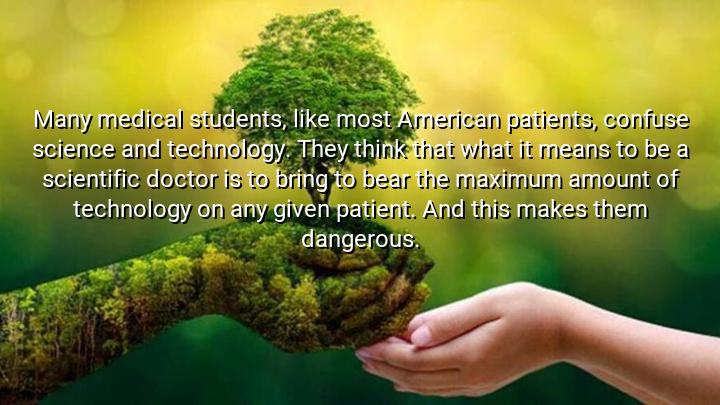




The quote by Alice Dreger critiques a common misconception in medicine regarding the roles of science and technology. She observes that many medical students and American patients mistakenly equate being a scientific doctor with using the maximum amount of technology on patients. This highlights a misunderstanding of the essence of medical science, which is not merely about tools, but about critical thinking, judgment, and patient-centered care.
Dreger warns that an overreliance on technology can be dangerous. While technological tools such as imaging, diagnostics, and surgical devices are invaluable, they cannot replace the nuanced decision-making that comes from rigorous scientific reasoning. The quote emphasizes that doctors must balance technological capabilities with careful analysis, empathy, and clinical judgment to provide safe and effective care.
This statement also reflects Dreger’s broader critique of medical culture and education. She stresses the importance of teaching future doctors to distinguish between the application of technology and the deeper principles of science. By pointing out this distinction, Dreger encourages a more thoughtful, reflective approach to patient care that prioritizes understanding and judgment over mere technical intervention.
Originating from Alice Dreger, a noted medical ethicist and historian of science, this quote captures her concern about the potential hazards of conflating science and technology in healthcare. It serves as a cautionary reminder that true scientific practice in medicine requires critical thinking, ethical awareness, and careful integration of technology—not just its uncritical application.
I can also create a version with extra bolding on all the key concepts for stronger visual emphasis if you want.

AAdministratorAdministrator
Welcome, honored guests. Please leave a comment, we will respond soon