

Man is an intelligence in servitude to his organs.
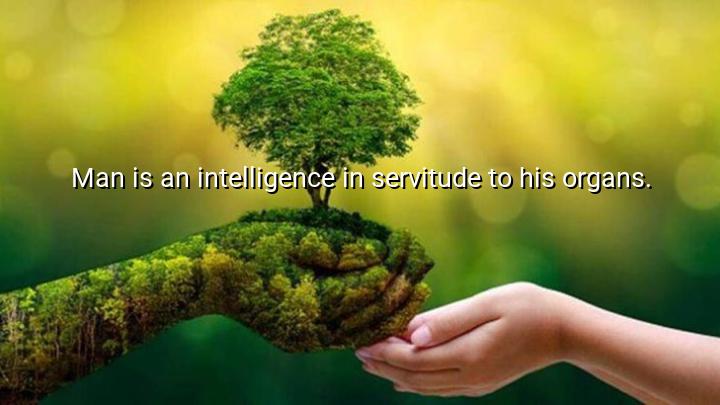




Aldous Huxley’s quote, "Man is an intelligence in servitude to his organs," explores the idea that human intelligence, while powerful and complex, is ultimately dependent on the physical body. Huxley suggests that despite our mental capabilities and cognitive powers, our bodies—and specifically our organs—control many of our actions, behaviors, and limitations. This relationship between the mind and the body highlights the tension between our intellectual aspirations and the biological constraints we face.
In this quote, intelligence is seen as something that can develop abstract thoughts, reason, and create, but it is constantly subjected to the biological needs and urges of the body. For example, the need for food, sleep, or the body's automatic responses to physical stimuli can overpower intellectual thoughts and decisions. Huxley is reflecting on how our cognitive abilities, while advanced, are always influenced by our physical existence, meaning we are not fully free from the demands of our biology.
Huxley’s statement can be interpreted as a comment on the limitations that the human body places on the mind. Even though humans have achieved incredible intellectual feats, we remain beholden to the basic needs and instincts of our organism. Our thoughts, desires, and ambitions are shaped by the condition of our bodies, such as when illness, fatigue, or aging impairs mental function. This view calls attention to the biological underpinnings of human existence and the way they ultimately affect even the most sophisticated human achievements.
The origin of this quote is rooted in Huxley’s philosophical views, which often explored the relationship between the mind, body, and the human experience. As a writer and thinker, Huxley examined the limitations and contradictions within human nature, particularly in works like Brave New World and The Perennial Philosophy. His interest in the intersection of science, philosophy, and psychology helped him to critique the balance between intellectual and physical realities, a theme encapsulated in this quote.

AAdministratorAdministrator
Welcome, honored guests. Please leave a comment, we will respond soon