

Man can and must prevent the tragedy of famine in the future instead of merely trying with pious regret to salvage the human wreckage of the famine, as he has so often done in the past.
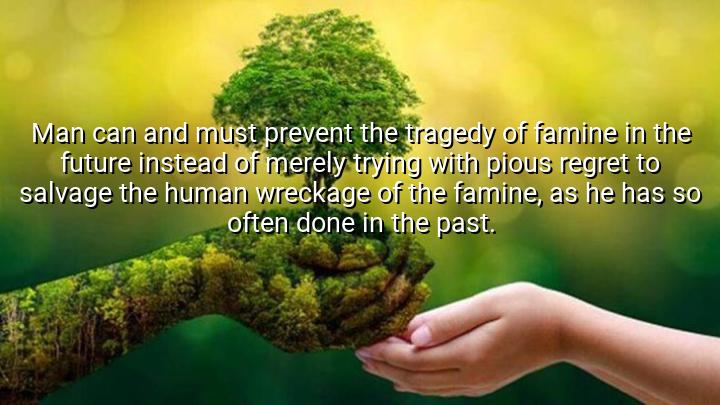




Norman Borlaug’s quote, "Man can and must prevent the tragedy of famine in the future instead of merely trying with pious regret to salvage the human wreckage of the famine, as he has so often done in the past," reflects his belief in proactive solutions to global hunger and famine. Borlaug, known for his work in agriculture and the development of high-yield crops, argues that humanity must shift its approach from merely responding to the aftermath of famine to actively preventing it from happening in the first place. This perspective challenges the common reaction of offering aid and expressing regret after a crisis, instead advocating for prevention through innovation and sustainable agricultural practices.
Borlaug highlights the importance of foresight, saying that humans must take action to ensure that famine does not occur, rather than waiting until the devastation has already unfolded. He criticizes the habitual response of focusing on relief efforts without addressing the underlying causes of famine, such as food scarcity and poor agricultural infrastructure. His statement urges a shift from short-term solutions to long-term strategies that can sustainably feed growing populations.
The phrase "pious regret" refers to the emotional and often symbolic responses that occur after a disaster, where people express sorrow without taking meaningful steps to address the root causes. Borlaug’s quote serves as a critique of this approach, advocating instead for practical action and innovation to prevent food insecurity. He emphasizes that humanity’s collective responsibility is to create lasting solutions, particularly through advancements in science and technology, rather than offering temporary fixes.
Ultimately, Borlaug’s message is one of hope and empowerment—he believes that it is within human capacity to eliminate famine through agricultural advancements and responsible resource management. His work in the Green Revolution demonstrated the possibility of improving global food production, and this quote encapsulates his lifelong dedication to finding sustainable ways to feed the world’s population and prevent future famines.

AAdministratorAdministrator
Welcome, honored guests. Please leave a comment, we will respond soon