

Love is that condition in which the happiness of another person is essential to your own... Jealousy is a disease, love is a healthy condition. The immature mind often mistakes one for the other, or assumes that the greater the love, the greater the jealousy.
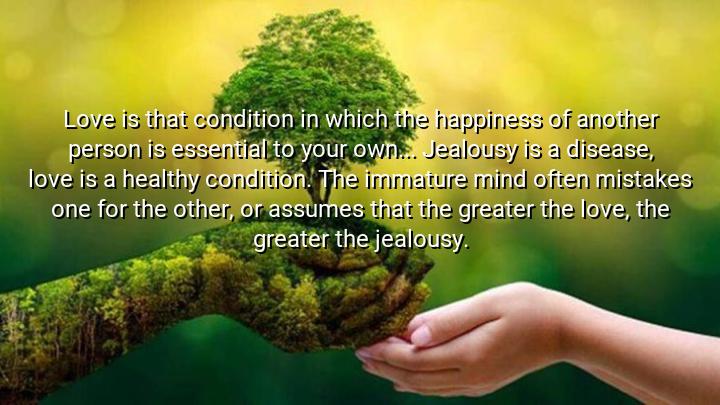




Robert A. Heinlein’s quote, "Love is that condition in which the happiness of another person is essential to your own... Jealousy is a disease, love is a healthy condition," draws a clear distinction between the concepts of love and jealousy. Heinlein suggests that true love is selfless, where the well-being of the person you love is just as important as, or more important than, your own happiness. In contrast, jealousy arises from insecurity and a desire to control, making it an unhealthy emotion. Love, according to Heinlein, thrives on mutual respect and concern, while jealousy corrupts these qualities, turning love into a possessive, harmful force.
The second part of the quote, "The immature mind often mistakes one for the other, or assumes that the greater the love, the greater the jealousy," highlights how immaturity can distort the understanding of love. Often, people in immature relationships confuse jealousy with love, thinking that intense emotions of possessiveness or fear of loss are signs of deep affection. Heinlein challenges this misconception, asserting that jealousy does not strengthen love but instead weakens it by creating an unhealthy power dynamic. True love, in his view, involves trust, freedom, and a willingness to allow your partner to grow without fear of losing them.
Heinlein's distinction between love and jealousy also points to a broader theme in his work, which often explores the psychological complexities of relationships. His perspective on love is that it is a mature, healthy connection that fosters growth and understanding, while jealousy is a toxic emotion that stems from fear and insecurity. By drawing this contrast, Heinlein emphasizes the importance of self-awareness and emotional maturity in cultivating genuine, lasting relationships.
Ultimately, Heinlein’s quote serves as a reminder that love should be rooted in care and respect for the other person’s happiness, not in controlling or possessing them. By recognizing jealousy as a destructive force, individuals can better understand the nature of healthy relationships and work towards cultivating love that is free from fear, insecurity, and possessiveness.

AAdministratorAdministrator
Welcome, honored guests. Please leave a comment, we will respond soon