

Love is a mutual self-giving which ends in self-recovery.
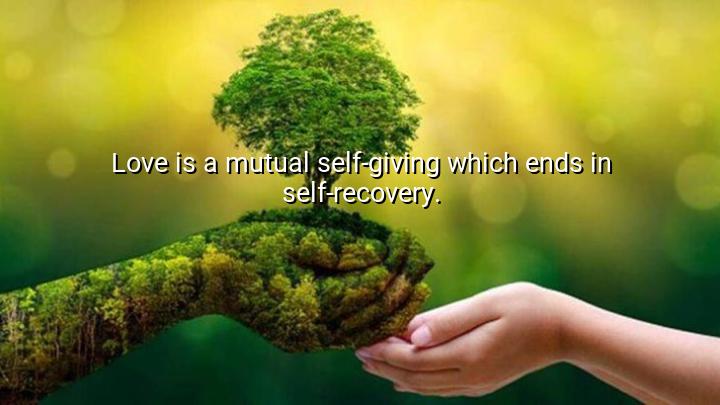




The quote, "Love is a mutual self-giving which ends in self-recovery," by Fulton J. Sheen, emphasizes the reciprocal and transformative nature of love. Sheen suggests that true love involves giving of oneself fully to another person, yet this act of generosity ultimately leads to personal growth, renewal, and deeper self-understanding. In other words, love is both outward-focused and inward-enriching, creating a cycle of giving and receiving that benefits both parties.
The origin of this quote comes from Fulton J. Sheen, an American archbishop, author, and television personality known for his writings on spirituality, ethics, and human relationships. Sheen frequently explored the moral and psychological dimensions of love, portraying it as a profound and transformative force. By framing love as “mutual self-giving,” he underscores that love is not selfish or one-sided but requires empathy, sacrifice, and reciprocity.
On a deeper level, the quote reflects how authentic love nurtures the soul. When individuals give themselves in love—through kindness, attention, or understanding—they do not lose themselves; rather, they discover and reclaim deeper parts of their own identity. Sheen’s insight highlights that love fosters self-awareness, emotional growth, and fulfillment, showing that true connection benefits both the giver and the receiver.
Ultimately, "Love is a mutual self-giving which ends in self-recovery" serves as a reminder that love is both selfless and restorative. Fulton J. Sheen’s words encourage embracing love as a shared journey, demonstrating that when we give fully to others, we ultimately enrich and renew our own lives, making love a source of healing, insight, and personal transformation.
I can also create a short, concise version suitable for a social media post or quote card if you want.

AAdministratorAdministrator
Welcome, honored guests. Please leave a comment, we will respond soon