

Loss of hope rather than loss of life is what decides the issues of war. But helplessness induces hopelessness.
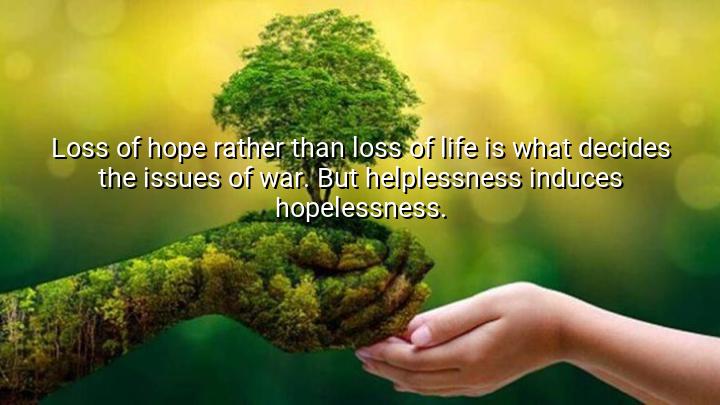




The quote "Loss of hope rather than loss of life is what decides the issues of war. But helplessness induces hopelessness" comes from B. H. Liddell Hart, a British military strategist and historian. In this statement, Liddell Hart emphasizes the psychological aspect of war, arguing that it is not necessarily the loss of life that determines the outcome of a conflict, but the loss of hope. The morale of both soldiers and civilians can have a more significant impact on the direction and outcome of war than the physical casualties alone.
Liddell Hart suggests that hope plays a crucial role in sustaining the will to continue fighting. When people or nations lose their hope—whether because of prolonged conflict, poor leadership, or a perceived inability to succeed—they are more likely to surrender or seek peace. In this context, hope is the driving force that keeps soldiers and civilians committed to a cause, while its loss can lead to the collapse of morale, and ultimately, the defeat of the side that once had the will to fight.
The second part of the quote, "But helplessness induces hopelessness," suggests that when people or nations feel powerless to change their situation—when they believe that victory is unattainable or that they are unable to influence the outcome—their hope diminishes. Helplessness can create a sense of futility, making it harder to maintain the resolve necessary to continue fighting. In this way, hopelessness becomes a self-fulfilling prophecy, where the lack of belief in success leads to defeat.
Ultimately, Liddell Hart’s quote highlights the profound psychological dynamics at play in war, showing that hope and morale can often be more decisive than physical strength or casualties. His words stress the importance of maintaining belief in the possibility of success and the dangers of allowing helplessness to dominate, as it can lead to the collapse of resistance and the loss of the will to fight.

AAdministratorAdministrator
Welcome, honored guests. Please leave a comment, we will respond soon