

Learning has always been made much of, but forgetting has always been deprecated; therefore pedantry has pretty well established itself throughout the modern world at the expense of culture.
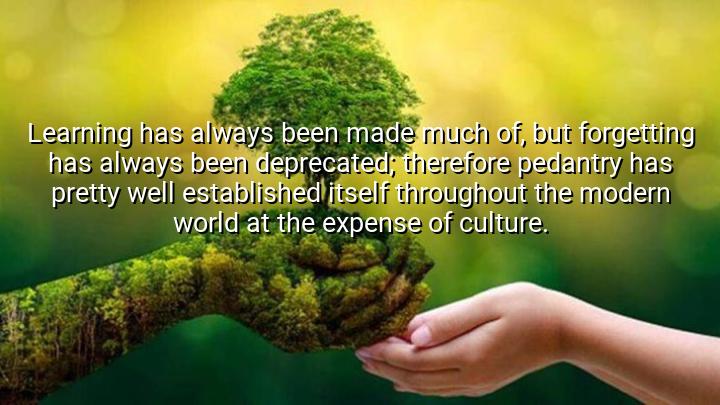




Albert J. Nock’s quote critiques the modern emphasis on learning and the undervaluing of forgetting. He argues that pedantry, or an excessive focus on the mere accumulation of knowledge, has taken over contemporary society. According to Nock, this has led to a situation where learning is prioritized above all else, often at the cost of true culture. He suggests that by disregarding the value of forgetting and reflection, we have created a culture of superficial knowledge, where memorization and the rote acquisition of facts are overemphasized, leaving little room for deeper understanding and wisdom.
The origin of this quote comes from Nock's observations as a cultural critic and educator in the early 20th century. Nock believed that the modern world had become overly focused on practical knowledge and intellectual competence, often neglecting more profound and reflective forms of understanding. For him, culture was not simply about accumulating information, but about developing wisdom, which involved learning to reflect and also learning to forget in order to make space for more meaningful insights.
Nock’s statement highlights the idea that forgetting can be just as important as learning in the development of culture. He believed that a person’s ability to let go of outdated or irrelevant information is essential for mental clarity and growth. In contrast, pedantry—the obsession with facts and details without considering their deeper meaning—can create a shallow intellectual environment, where true learning is lost in a sea of trivial knowledge. In his view, this results in the loss of a more holistic understanding of life and culture.
Ultimately, Nock’s quote serves as a warning against a narrow, fact-obsessed view of education and learning. It suggests that in our rush to accumulate knowledge, we risk overlooking the more subtle, but essential, aspects of culture and wisdom that come from introspection, forgetting, and allowing space for deeper thought. His critique calls for a more balanced approach to education, one that values both learning and forgetting as part of a more comprehensive understanding of the world.

AAdministratorAdministrator
Welcome, honored guests. Please leave a comment, we will respond soon